What Does Competency-Based Learning Mean?

April 22, 2026 | 13 minutes | 656 Readers

Competency-Based Learning focuses on mastering skills and knowledge rather than time spent studying. It allows learners to progress at their own pace by demonstrating real understanding, making education more flexible, personalised, and outcome-driven.

rating

Bestselling Course

View Details SAVE 94% NOW

What if your progress depended on what you can do, not how long you study? For decades, traditional education has measured success by time spent in classrooms, fixed schedules, and standardised exams. However, in today’s fast-paced, skills-driven world, this approach often falls short of preparing learners for real-life challenges and evolving career demands.

Competency-Based Learning (CBL) offers a modern alternative by focusing on mastery rather than time. In simple terms, it allows learners to progress by demonstrating their knowledge and skills, ensuring they truly understand a subject before moving forward. Instead of following a rigid timeline, individuals learn at their own pace, making education more personalised and effective.

This approach matters now more than ever. Employers increasingly value practical skills, adaptability, and real-world problem-solving over theoretical knowledge alone. Competency-Based Learning supports these expectations by prioritising outcomes, flexibility, and applied learning—helping individuals build confidence, develop relevant expertise, and stay competitive in a rapidly changing world.

What Is Competency-Based Learning?

Competency-based learning is an approach within competency-based education where learners progress by demonstrating their understanding and ability to apply knowledge, rather than simply completing a set amount of study time. It focuses on mastery learning, meaning students must fully grasp each concept or skill before moving on to the next stage.

In this model, learning is structured around clearly defined outcomes, allowing individuals to develop practical, real-world abilities through skill-based learning. Progress is personalised, so learners can move faster through familiar topics or take additional time where needed. This ensures a deeper understanding and stronger retention of knowledge.

Ultimately, competency-based learning prioritises what learners can do with what they know. By emphasising proven competence over time spent studying, it creates a more flexible, efficient, and results-driven learning experience.

Key Principles of Competency-Based Learning

Key Principles of Competency-Based Learning

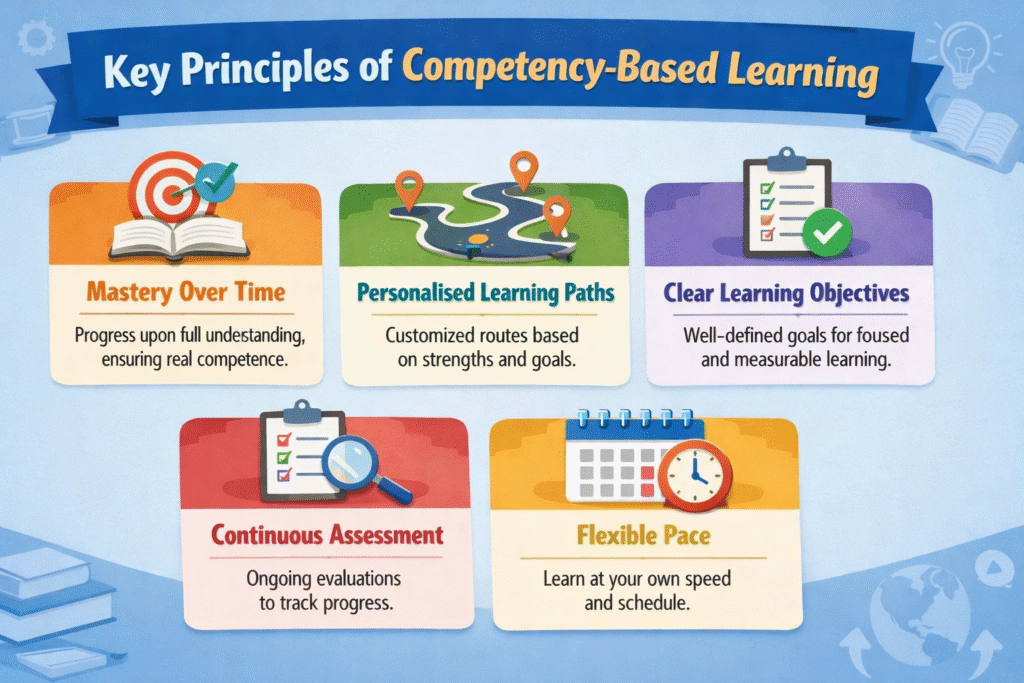
Key Principles of Competency-Based Learning focus on ensuring learners achieve true understanding and practical skills rather than simply completing a course within a set timeframe. This approach emphasises mastery, personalised learning paths, clear objectives, continuous assessment, and flexible pacing, allowing individuals to progress based on their ability. As a result, learners gain deeper knowledge, improved confidence, and more meaningful outcomes aligned with real-world application.

1. Mastery Over Time

 Learners progress only when they fully understand a concept, rather than moving forward based on fixed timelines. This ensures strong knowledge retention and real competence in each subject area.

2. Personalised Learning Paths

 Each learner follows a customised route based on their strengths, weaknesses, and goals. This approach allows individuals to focus on areas that need improvement while advancing quickly through familiar topics.

3. Clear Learning Objectives

Well-defined goals outline exactly what learners are expected to achieve. This clarity helps individuals stay focused, measure progress effectively, and understand the purpose of each learning activity.

4. Continuous Assessment

Regular evaluations are used to track progress and identify learning gaps. Instead of relying on final exams, ongoing assessments provide timely feedback and support consistent improvement.

5. Flexible Pace

Learners can study at a speed that suits their individual needs and schedules. This flexibility reduces pressure, accommodates different learning styles, and improves overall engagement and success.

How Competency-Based Learning Works​

How Competency-Based Learning Works

Competency-based learning focuses on what learners can actually do with their knowledge rather than how long they study. It ensures practical understanding and real skill development, allowing learners to progress based on their ability.

The process starts with clearly defined competencies—specific skills or knowledge areas learners must achieve. These act as measurable goals, helping learners focus on applying concepts, solving problems, and completing tasks effectively.

Learners then study at their own pace, moving quickly through familiar topics and spending more time on challenging ones. This flexibility creates a personalised learning experience and reduces pressure from fixed timelines.

Finally, learners are assessed based on mastery. They progress only after demonstrating real understanding, with the option to revisit topics if needed, ensuring strong knowledge retention and confidence.

Benefits of Competency-Based Learning

Competency-Based Learning offers a more effective approach by allowing learners to progress based on their ability to demonstrate understanding. This results in faster and more efficient learning, as individuals can skip what they already know and focus on areas that need improvement. It removes unnecessary repetition and ensures time is used productively.

Another key advantage is the personalised learning experience it provides. Each learner can study at their own pace, aligning their learning journey with their strengths, goals, and preferred style. This flexibility increases engagement and makes the overall experience more relevant and motivating.

This approach also leads to better retention of knowledge. Since learners must fully grasp each concept before moving forward, they develop a deeper understanding. This not only helps them remember information for longer but also enables them to apply their knowledge more effectively in real-life situations.

Furthermore, Competency-Based Learning builds increased confidence while ensuring stronger career relevance. As learners achieve clear milestones, they gain a sense of accomplishment that boosts self-belief. At the same time, the focus on practical, job-related skills prepares them for real-world roles, helping them add meaningful value to their professional development.

Competency-Based Learning vs Traditional Learning

Competency-Based Learning vs Traditional Learning

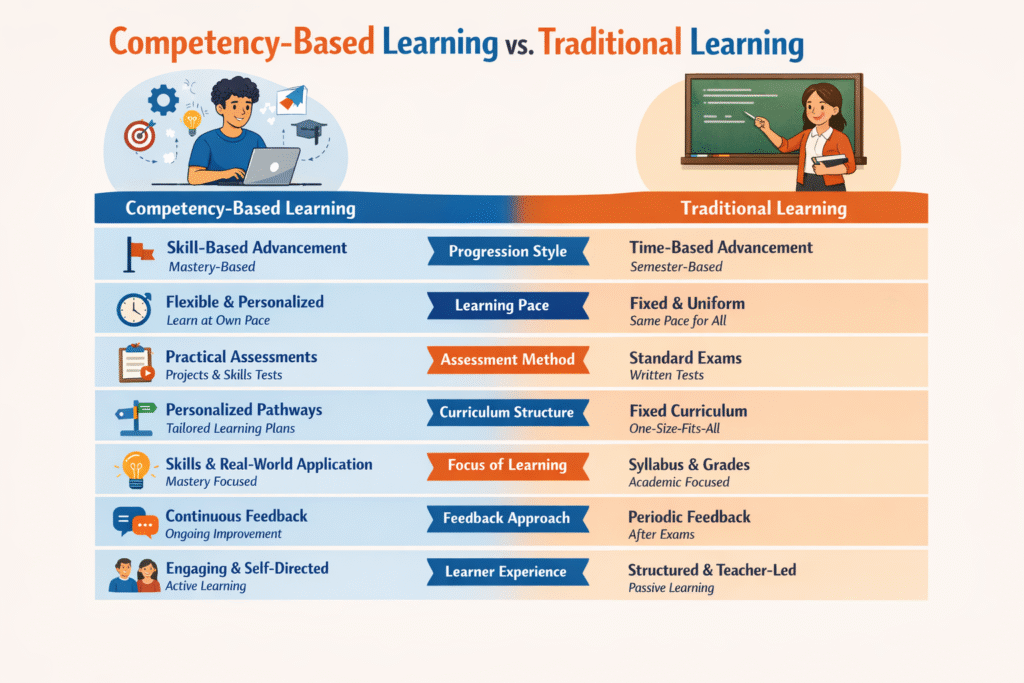
Understanding the difference between competency-based learning and traditional learning is essential for choosing the right educational approach. While traditional learning has long been the standard, focusing on structured timelines and exams, competency-based learning is gaining popularity for its emphasis on skills, flexibility, and real-world application. The comparison below highlights how these two approaches differ across key areas:

Aspect Competency-Based Learning Traditional Learning
Progression Style Skill-based progression where learners advance only after mastering specific competencies. Focus is on ability and understanding. Time-based progression where learners move forward based on semesters or academic schedules, regardless of mastery level.
Learning Pace Flexible and personalised; learners progress at their own speed depending on their understanding. Fixed pace; all students follow the same timeline, which may not suit individual learning needs.
Assessment Method Practical assessments such as real-world tasks, projects, and demonstrations of skills. Standard exams and written tests that focus more on theoretical knowledge.
Curriculum Structure Personalised learning paths tailored to individual strengths, weaknesses, and career goals. Fixed curriculum with a one-size-fits-all approach for all learners.
Focus of Learning Emphasises mastery of skills and real-world application. Emphasises completion of syllabus and academic performance.
Feedback Approach Continuous feedback to support improvement and skill development. Periodic feedback, usually after exams or assignments.
Learner Experience More engaging and practical, encouraging active participation and self-directed learning. More structured and teacher-led, often with passive learning methods.
Real-World Examples of Competency-Based Learning

Real-World Examples of Competency-Based Learning

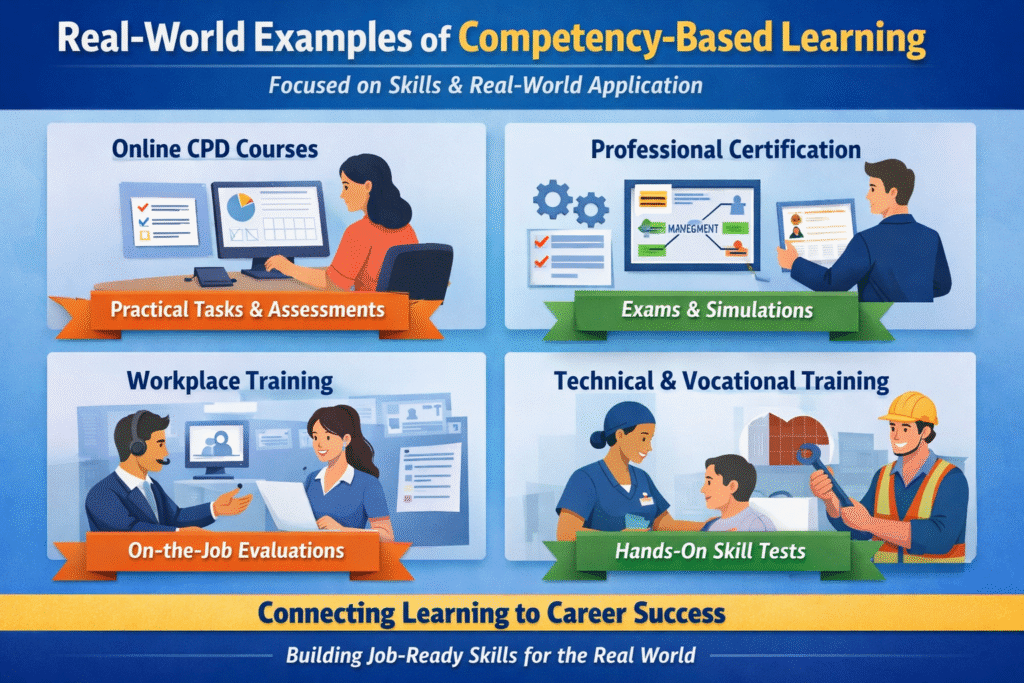
Competency-based learning focuses on what learners can do rather than how long they study. It is widely used across education and professional settings to ensure skills are practical, measurable, and job-ready. Below are concise real-world applications across key areas:

Online CPD Courses

Online CPD courses use assessments and practical tasks to confirm skill development. Instead of passive learning, learners may complete activities like creating reports, analysing data, or applying concepts to real scenarios. Progress depends on demonstrating understanding, making learning flexible and outcome-focused.

Professional Certification Programmes

Certification programmes in fields like project management, IT, and finance assess learners through exams, case studies, and simulations. Candidates must prove competence in specific areas, ensuring they gain practical, industry-relevant skills rather than just theoretical knowledge.

Workplace Training and Upskilling

Companies use competency-based training to improve employee performance. Staff are assessed through real-life tasks, such as handling customer interactions or completing job-specific duties. This ensures training directly enhances workplace effectiveness and addresses skill gaps.

Technical and Vocational Training

In vocational fields like healthcare, construction, and engineering, learners must demonstrate hands-on skills. For example, tasks like performing procedures or operating equipment are assessed in real conditions, ensuring learners meet industry standards and are job-ready.

Why It Matters

These examples show how competency-based learning connects education with real-world application. It builds confidence, improves performance, and ensures learners develop skills that are immediately useful in their careers.

Challenges and Limitations While competency-based learning offers flexibility and personalised progress, it also comes with certain challenges that can impact its effectiveness. One of the primary concerns is the need for strong self-discipline. Since learners often progress at their own pace, those who lack motivation or time-management skills may struggle to stay consistent and complete the programme successfully. Another limitation is that competency-based learning is not yet universally adopted. Many institutions and employers still rely on traditional grading systems, which can create inconsistencies in recognition and acceptance. As a result, learners may sometimes find it difficult to align competency-based achievements with conventional academic or professional expectations. Additionally, designing effective assessments within this model can be complex. Measuring true competency requires well-structured, practical, and often personalised evaluation methods. This can demand more time, expertise, and resources from educators, making implementation more challenging compared to standard assessment approaches.

Challenges and Limitations

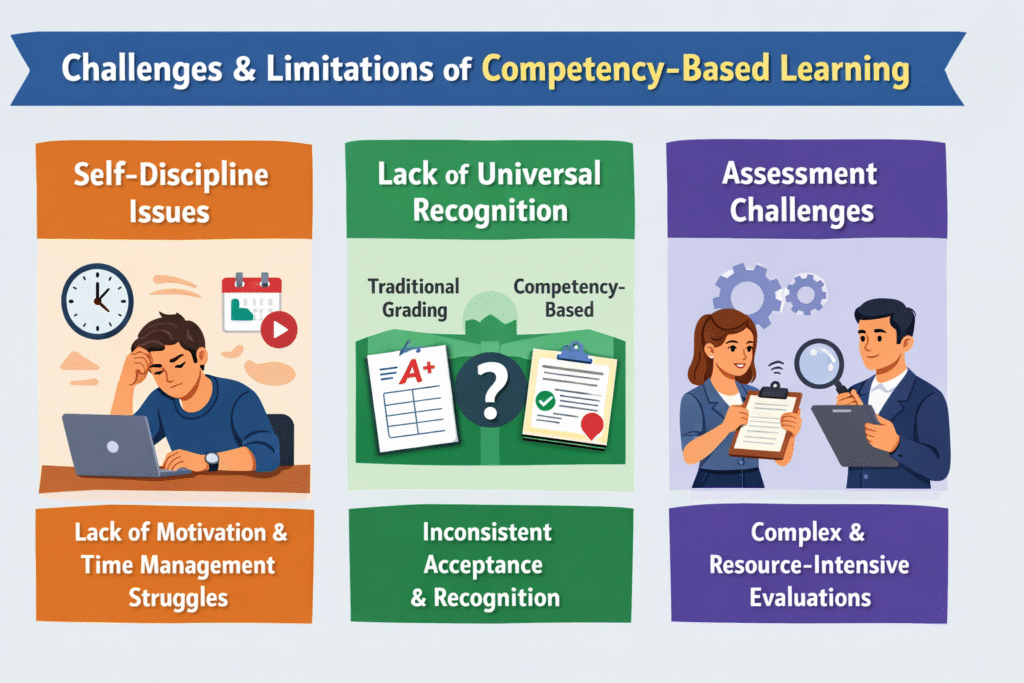
While competency-based learning offers flexibility and personalised progress, it also comes with certain challenges that can impact its effectiveness. One of the primary concerns is the need for strong self-discipline. Since learners often progress at their own pace, those who lack motivation or time-management skills may struggle to stay consistent and complete the programme successfully.

Another limitation is that competency-based learning is not yet universally adopted. Many institutions and employers still rely on traditional grading systems, which can create inconsistencies in recognition and acceptance. As a result, learners may sometimes find it difficult to align competency-based achievements with conventional academic or professional expectations.

Additionally, designing effective assessments within this model can be complex. Measuring true competency requires well-structured, practical, and often personalised evaluation methods. This can demand more time, expertise, and resources from educators, making implementation more challenging compared to standard assessment approaches.

Who Can Benefit from Competency-Based Learning?

Competency-based learning is flexible, practical, and focused on real-world skills, making it suitable for a wide range of learners. It allows individuals to progress at their own pace while aligning learning with personal and professional goals.

Students and Beginners

 It helps new learners build strong foundations without the pressure of fixed timelines. By focusing on true understanding, they gain confidence and develop job-ready skills that enhance their CVs.

Working Professionals

Professionals can upskill without interrupting their careers. By learning specific competencies, they can apply knowledge directly at work, improving performance and career growth opportunities.

Working Professionals

Professionals can upskill without interrupting their careers. By learning specific competencies, they can apply knowledge directly at work, improving performance and career growth opportunities.

Career Changers

 Those switching careers can focus only on relevant skills needed for their new field. This targeted approach saves time and helps them become competitive more quickly.

Lifelong Learners

 Individuals committed to continuous development can benefit from ongoing skill-building. This approach supports personal growth, adaptability, and staying relevant in a changing world.

Future of Competency-Based Learning

Future of Competency-Based Learning

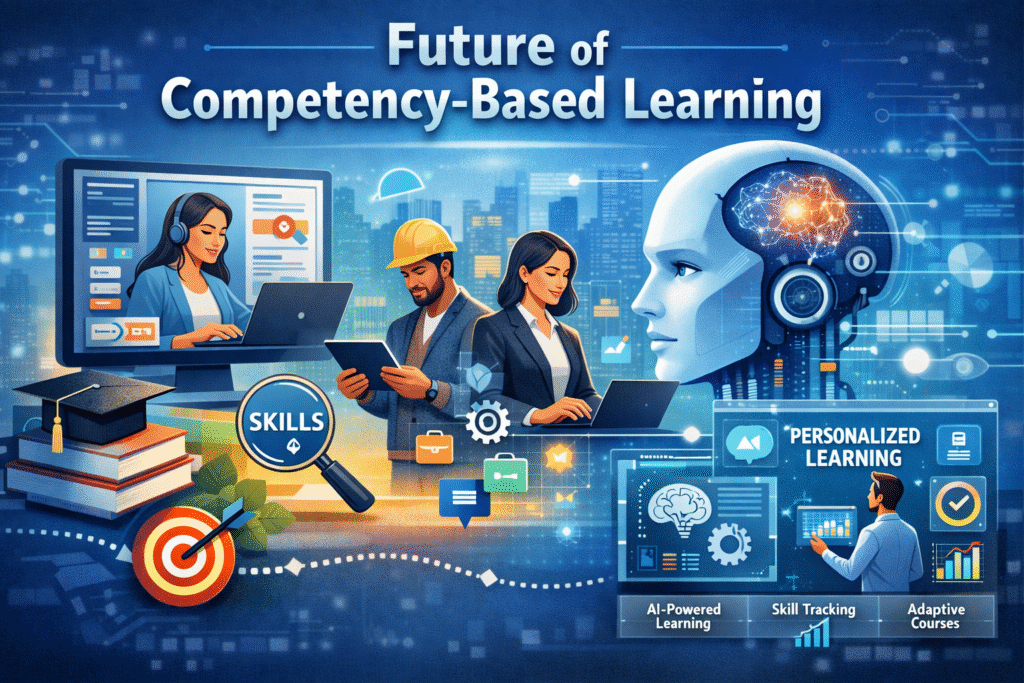
The future of competency-based learning is driven by a growing focus on skills over traditional degrees. Employers increasingly value what individuals can do rather than their qualifications, encouraging learners to choose education models that build real-world competence and job-ready abilities.

At the same time, the rise of online learning platforms is making this approach more accessible and flexible. Learners can develop skills at their own pace, without location or time restrictions, supporting continuous professional development and helping them stay competitive.

Looking ahead, Artificial Intelligence (AI) will further transform competency-based learning by enabling personalised education. AI can track progress, identify skill gaps, and tailor learning experiences, ensuring learners achieve mastery in a more efficient and targeted way.

Conclusion

Competency-based learning emphasises mastering practical skills and real-world abilities rather than simply completing coursework, allowing learners to progress at their own pace and truly understand what they learn. In a modern, competitive job market, this skill-focused approach is essential, as employers increasingly prioritise proven capabilities over traditional credentials. By focusing on what you can actually do, competency-based learning supports personal growth, confidence, and career readiness—so if you’re looking to advance, now is the perfect time to explore relevant courses and start building the skills that matter most.

FAQs — What Does Competency-Based Learning Mean?

1. What is competency-based learning in simple terms?
Competency-based learning is an approach where learners progress by demonstrating skills and knowledge, rather than spending a fixed amount of time studying.

2. How does it differ from traditional education?
Unlike traditional education, which follows a set schedule, competency-based learning allows learners to move forward once they fully understand a topic.

3. Is competency-based learning effective?
Yes, it is effective because it focuses on mastery, ensuring learners fully understand each concept before progressing.

4. Can learners finish courses faster?
Yes, learners can complete courses faster if they already have prior knowledge or can quickly demonstrate competency.

5. Who uses competency-based education?
It is used by schools, universities, and online learning platforms, especially for professional and skills-based training.

Sam Walker

Article by

Sam Walker

Sam Walker is an education specialist and author at One Education, bringing over 4 years of experience in creating practical resources and strategies to support teachers and enhance student learning.

top
Home Courses Search