What is a Sum in Math? Definition, Properties, and Uses

May 07, 2026 | 13 minutes | 12 Readers

Whether you’re adding up prices while shopping, calculating your total marks in an exam, or managing your monthly budget, you’re using one simple yet powerful mathematical idea—the sum. It’s something we rely on in everyday life, often without even realising it. In mathematics, a sum refers to the result of adding two or more numbers together. Although it may seem basic, it is one of the most fundamental concepts in maths and serves as a building block for many advanced

Whether you’re adding up prices while shopping, calculating your total marks in an exam, or managing your monthly budget, you’re using one simple yet powerful mathematical idea—the sum. It’s something we rely on in everyday life, often without even realising it.

In mathematics, a sum refers to the result of adding two or more numbers together. Although it may seem basic, it is one of the most fundamental concepts in maths and serves as a building block for many advanced topics, from algebra to calculus. Understanding how sums work not only strengthens your numerical skills but also helps you solve real-world problems more effectively.

What is a Sum in Math?

In mathematics, a sum is the result you get when you add two or more numbers together. Addition is one of the most basic and important operations in math, and the sum is simply the final answer.

Simple Example

If you add 2 and 3:
2 + 3 = 5

Here, 5 is called the sum.

Key Terms to Know

  • ♦  Addends: These are the numbers that you are adding together.
    • In the example 2 + 3 = 5, the numbers 2 and 3 are addends.
  • ♦  Sum: This is the final result after adding the addends.
    • In the same example, 5 is the sum.

Why It Matters

Understanding what a sum is helps build a strong foundation in math. Whether you’re counting objects, solving problems, or working with bigger numbers, addition and sums are used everywhere.

Parts of an Addition Problem​

Parts of an Addition Problem

Understanding the parts of an addition problem helps make basic maths clearer and easier to follow. Each component has a specific role in forming the complete equation.

1. Addends

Addends are the numbers that are being added together. These are the starting values in an addition problem.
In the example 7 + 4 = 11, both 7 and 4 are addends.

2. Plus Sign (+)

The plus sign (+) is the symbol that tells you to add the numbers. It indicates that the values on either side should be combined.

3. Equals Sign (=)

The equals sign (=) shows that the expression on the left is equal to the value on the right. It represents the result of the addition.

4. Sum

The sum is the final answer you get after adding the addends together.
In the example 7 + 4 = 11, the number 11 is the sum.

Example Explained

7 + 4 = 11

  • ♦  7 and 4 → Addends
  • ♦  + → Plus sign (addition symbol)
  • ♦  = → Equals sign (shows the result)
  • ♦  11 → Sum

Upgrade your skills and expand your knowledge with professional online courses at One Education

Properties of a Sum in Mathematics

Properties of a Sum in Mathematics

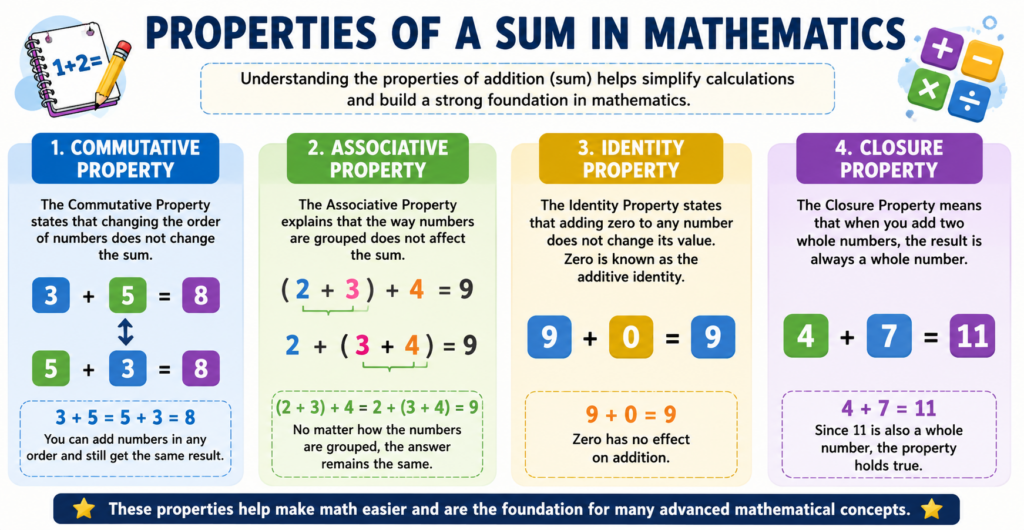
Understanding the properties of addition (sum) helps simplify calculations and build a strong foundation in mathematics. These properties apply to whole numbers and are widely used in everyday problem-solving.

1. Commutative Property

The Commutative Property states that changing the order of numbers does not change the sum.

In simple terms, you can add numbers in any order and still get the same result.

Example:
3 + 5 = 5 + 3 = 8

This property makes calculations easier, especially when working with larger numbers.

2. Associative Property

The Associative Property explains that the way numbers are grouped does not affect the sum.

This is helpful when adding multiple numbers together.

Example:
(2 + 3) + 4 = 2 + (3 + 4) = 9

No matter how the numbers are grouped, the answer remains the same.

3. Identity Property

The Identity Property states that adding zero to any number does not change its value.

Zero is known as the additive identity.

Example:
9 + 0 = 9

This property shows that zero has no effect on addition.

4. Closure Property

The Closure Property means that when you add two whole numbers, the result is always a whole number.

Example:
4 + 7 = 11

Since 11 is also a whole number, the property holds true.

Different Types of Sums

Different Types of Sums

In mathematics, a sum simply means the result of addition. However, sums can take many different forms depending on the type of numbers or expressions involved. Understanding these variations helps build strong problem-solving skills and makes it easier to apply maths in real-life situations.

1. Simple Sums (Small Numbers)

Simple sums involve adding small numbers, usually single-digit or low-value numbers. These are the first type of sums learners encounter.

Examples:

  • ♦  2 + 3 = 5
  • ♦  7 + 1 = 8

Why it matters:
Simple sums build the foundation for all other mathematical operations. Mastering them improves mental maths and speed.

2. Large Number Sums

Large number sums involve adding numbers with multiple digits. These often require structured methods such as column addition and carrying.

Examples:

  • ♦  245 + 378 = 623
  • ♦  1,250 + 3,475 = 4,725

Why it matters:
This type of sum is widely used in daily life, such as calculating expenses, budgets, and totals.

3. Decimal Sums

Decimal sums involve numbers with decimal points. The key rule is to align the decimal points before adding.

Examples:

  • ♦  2.5 + 1.3 = 3.8
  • ♦  4.75 + 2.25 = 7.00

Why it matters:
Decimal addition is essential in real-world situations like handling money, measurements, and scientific data.

4. Fraction Sums

Fraction sums involve adding parts of a whole. The method depends on whether the denominators are the same or different.

Examples:

  • ♦  Same denominator:
    1/4 + 2/4 = 3/4
  • ♦  Different denominators:
    1/2 + 1/3 = 3/6 + 2/6 = 5/6

Why it matters:
Fractions are used in cooking, construction, and measurements, making this skill highly practical.

5. Algebraic Sums

Algebraic sums involve variables (letters) along with numbers. The key concept is combining like terms.

Examples:

  • ♦  x + 2x = 3x
  • ♦  3a + 4a = 7a

Why it matters:
Algebraic sums are essential for solving equations, understanding patterns, and advancing into higher-level mathematics.

Real-Life Uses of Sums

Real-Life Uses of Sums

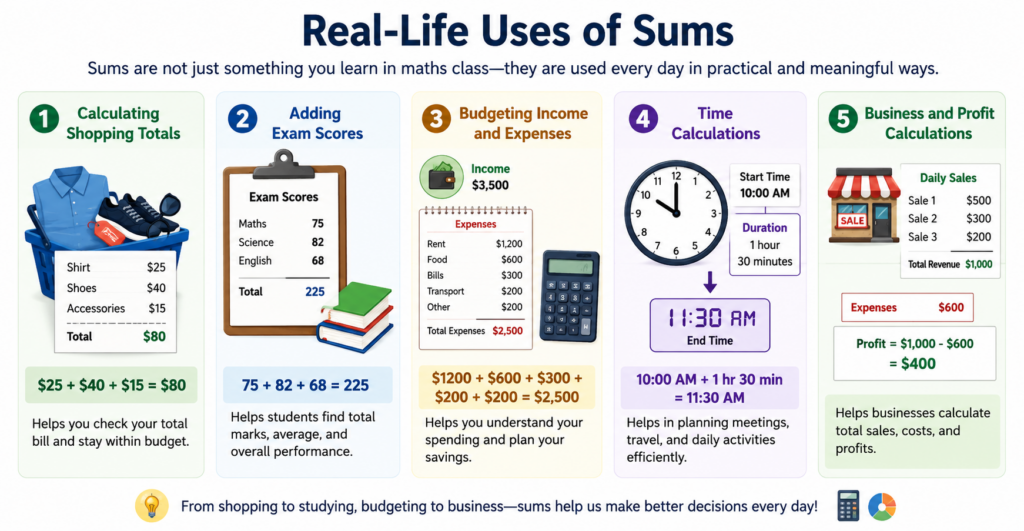
Sums are not just something you learn in maths class—they are used every day in practical and meaningful ways. From managing money to tracking time, addition plays a key role in helping us make decisions and stay organised.

1. Calculating Shopping Totals

Whenever you go shopping, you use sums to find out how much you need to pay. For example, if you buy a shirt for $25, shoes for $40, and accessories for $15, you add these amounts to get the total bill. This helps you check whether you are within your budget and ensures you pay the correct amount.

2. Adding Exam Scores

Students often need to calculate their total or average marks. For instance, if a student scores 75, 82, and 68 in three subjects, adding these scores gives the total performance. This sum can then be used to determine grades, averages, or overall progress.

3. Budgeting Income and Expenses

Sums are essential for managing personal finances. You add up your monthly income and then add all your expenses—such as rent, food, and bills—to see how much you are spending. This helps you understand whether you are saving money or overspending, allowing you to plan better financially.

4. Time Calculations

Addition is useful when working with time. For example, if a meeting lasts 1 hour and 30 minutes and starts at 10:00 AM, you add the duration to find that it ends at 11:30 AM. Similarly, adding time helps in planning schedules, travel, and daily activities efficiently.

5. Business and Profit Calculations

In business, sums are used to calculate total sales, costs, and profits. For example, if a shop sells items worth $500, $300, and $200 in a day, adding these gives total revenue. Businesses also add expenses to determine overall costs and subtract them from revenue to calculate profit.

Common Mistakes Students Make in Addition​

Common Mistakes Students Make in Addition

Even though addition is one of the most basic mathematical operations, students often make avoidable mistakes that can lead to incorrect answers. Understanding these common errors can help learners improve accuracy and confidence.

1. Forgetting to Carry Numbers

One of the most frequent mistakes occurs when adding multi-digit numbers. Students sometimes forget to “carry over” when the sum of digits in a column exceeds 9.

Example:
If you add 27 + 18, the correct process involves carrying over:
7 + 8 = 15 → write 5, carry 1
2 + 1 + 1 (carried) = 4

Ignoring the carry step results in incorrect answers. Careful step-by-step calculation helps avoid this issue.

2. Adding Unlike Terms Incorrectly

In algebra, students often try to add terms that are not similar. Only like terms (with the same variables and powers) can be added directly.

Incorrect:
3x + 4y = 7xy

Correct:
3x + 4y (cannot be simplified further)

Mixing unlike terms leads to confusion and incorrect results, especially in higher-level maths.

3. Misplacing Decimal Points

When working with decimal numbers, alignment is crucial. Students sometimes add numbers without lining up the decimal points, which changes the value entirely.

Example:
12.5 + 3.75
If not aligned properly, the result will be wrong.

Correct alignment:
12.50

  • ♦  3.75
    = 16.25

Always ensure decimals are placed directly under each other before adding.

4. Ignoring Brackets

Brackets indicate priority in calculations. Students often overlook them and perform addition in the wrong order.

Example:
5 + (3 + 2)

Correct approach: Solve inside the brackets first → 3 + 2 = 5
Then add → 5 + 5 = 10

Ignoring brackets can completely change the final answer, especially in complex expressions.

Tips to Solve Sums Easily

Tips to Solve Sums Easily

Solving sums doesn’t have to feel difficult or time-consuming. With a few practical techniques, you can improve both speed and accuracy while building confidence in maths.

1. Break Large Numbers into Smaller Parts

Big numbers can seem overwhelming at first glance. Instead of tackling them all at once, divide them into smaller, manageable parts.
For example, instead of adding 478 + 256 directly, break it down:

  • ♦  400 + 200 = 600
  • ♦  78 + 56 = 134
  • ♦  Total = 734

This method simplifies the process and reduces the chances of mistakes.

2. Use Mental Math Techniques

Mental maths helps you solve sums quickly without always relying on paper or a calculator. Techniques such as rounding numbers, using number bonds, or adjusting values can save time.
For instance, to add 49 + 32, think:

  • ♦  49 is close to 50 → 50 + 32 = 82
  • ♦  Subtract 1 → 81

Practising these shortcuts makes calculations faster and more efficient.

3. Double-Check Your Calculations

Even small errors can lead to incorrect answers. Always take a moment to review your work. You can:

  • ♦  Recalculate the sum
  • ♦  Use the reverse operation (e.g., subtraction to check addition)

This habit ensures accuracy and helps you identify common mistakes.

4. Practice Regularly

Consistency is key to improving maths skills. The more you practise, the more familiar different types of sums become. Over time, you’ll notice:

  • ♦  Faster problem-solving
  • ♦  Better accuracy
  • ♦  Increased confidence

Set aside a few minutes daily to solve different types of sums and gradually challenge yourself with more complex problems.

Conclusion

The concept of a sum is a fundamental part of mathematics that forms the basis for many calculations, from simple addition to more complex problem-solving. Its importance goes beyond academic learning, as sums are used in everyday activities such as budgeting, shopping, and measuring, making it a practical and essential skill. Developing a clear understanding of sums not only strengthens mathematical ability but also supports better decision-making in daily life, and with regular practice, learners can improve their accuracy, confidence, and overall proficiency in maths.

FAQs — What is a Sum in Math? Definition, Properties, and Uses

1. What is a sum in math?

A sum is the result obtained when two or more numbers are added together. It represents the total value after combining those numbers.

2. What does the term “sum” mean in addition?

In addition, the sum is the final answer you get after adding all the numbers involved in a calculation.

3. Can a sum involve more than two numbers?

Yes, a sum can include two or more numbers. For example, adding 2 + 3 + 5 gives a sum of 10.

4. What are the basic properties of a sum?

The key properties include the commutative property (order doesn’t matter), associative property (grouping doesn’t matter), and identity property (adding zero doesn’t change the number).

5. What is the commutative property of addition?

It means that changing the order of numbers does not affect the sum. For example, 4 + 6 is the same as 6 + 4.

Sam Walker

Article by

Sam Walker

Sam Walker is an education specialist and author at One Education, bringing over 4 years of experience in creating practical resources and strategies to support teachers and enhance student learning.

top
Home Courses Search