What Is Factorising in Math? Methods and Practices

May 06, 2026 | 14 minutes | 744 Readers

Have you ever tried solving a puzzle by breaking it down into smaller, more manageable pieces? Mathematics often works in a similar way. Instead of tackling a complex expression all at once, we can simplify it by splitting it into simpler parts—and this is exactly where factorising comes in. Factorising in maths is the process of breaking down an expression, number, or algebraic equation into a product of smaller factors that, when multiplied together, give the original result. It’s essentially

What Is Factorising in Math Methods and Practices

Have you ever tried solving a puzzle by breaking it down into smaller, more manageable pieces? Mathematics often works in a similar way. Instead of tackling a complex expression all at once, we can simplify it by splitting it into simpler parts—and this is exactly where factorising comes in.

Factorising in maths is the process of breaking down an expression, number, or algebraic equation into a product of smaller factors that, when multiplied together, give the original result. It’s essentially the reverse of expanding brackets and plays a key role in simplifying mathematical problems.

This concept is widely used in algebra to solve equations, reduce expressions, and understand relationships between numbers. Beyond the classroom, factorising also supports logical thinking and problem-solving skills that are useful in everyday situations, from calculating costs to analysing patterns.

In this article, you’ll learn what factorising really means, explore different methods used to factorise expressions, and discover practical techniques to apply these skills with confidence.

Common gallon conversion mistakes explained

What Is Factorising in Math?

Factorising in mathematics means breaking down a number or an expression into smaller parts that multiply together to give the original value. These smaller parts are called factors.

Simple Examples

To understand the idea clearly, look at these basic examples:

  • ♦  Numbers:
    👉 12 = 3 × 4
    Here, 3 and 4 are factors of 12.
  • ♦  Algebraic expressions:
    👉 x² + 5x = x(x + 5)
    In this case, the expression is rewritten as a multiplication of two factors: x and (x + 5).

Factorising Numbers vs Algebraic Expressions

Although the concept is the same, there is a slight difference in how factorising is applied:

  • ♦  Factorising numbers
    This involves breaking a number into smaller integers that multiply together.
    Example:
    20 = 2 × 2 × 5
  • ♦  Factorising algebraic expressions
    This involves finding common terms or patterns in variables and rewriting the expression as a product.
    Example:
    6x + 9 = 3(2x + 3)

In short, numbers deal with pure values, while algebraic expressions involve variables and terms.

Factorising vs Expanding

Factorising is actually the reverse process of expanding.

  • ♦  Expanding means multiplying brackets out:
    x(x + 5) = x² + 5x
  • ♦  Factorising means putting the expression back into brackets:
    x² + 5x = x(x + 5)

So, if expanding “opens up” an expression, factorising “packs it back” into a simpler multiplied form.

Why Factorising Matters

Factorising is a key skill in maths because it helps to:

  • ♦  Simplify complex expressions
  • ♦  Solve equations more easily
  • ♦  Understand the structure of algebra

Once you grasp this concept, many other areas of mathematics become much easier to handle.

Why Is Factorising Important?

Factorising is an essential mathematical skill because it helps solve equations more easily. By breaking down expressions into smaller factors, complex equations—especially quadratic ones—become simpler to manage. This allows you to identify solutions quickly without getting overwhelmed by lengthy calculations.

It also plays a key role in simplifying complex expressions. Large algebraic problems can often seem difficult at first, but factorising reduces them into more manageable parts. This makes it easier to perform further operations and improves overall clarity when working through mathematical problems.

Moreover, factorising is crucial for higher-level maths and real-life applications. It forms the foundation for topics like algebra and quadratics, while also helping in practical situations such as recognising patterns, grouping items efficiently, and solving optimisation problems. This makes it a valuable skill both academically and in everyday life.

Common gallon conversion mistakes explained

Common Methods of Factorising

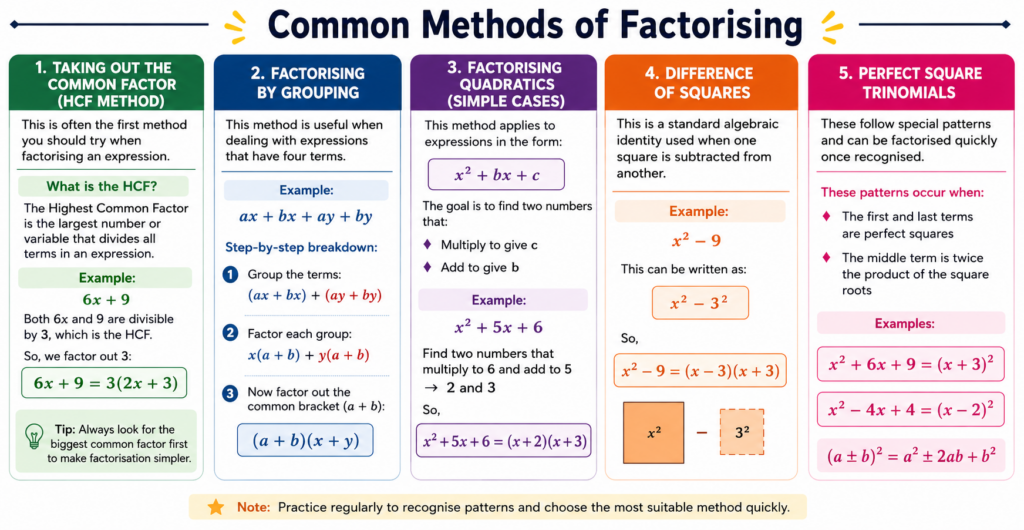
Factorising is a key algebraic skill that helps simplify expressions and solve equations more efficiently. Below are some of the most commonly used methods, each with clear explanations and examples.

Taking Out the Common Factor (HCF Method)

This is often the first method you should try when factorising an expression.

What is the Highest Common Factor (HCF)?
The Highest Common Factor is the largest number or variable that divides all terms in an expression.

Example:
6x + 9

Both 6x and 9 are divisible by 3, which is the HCF.

So, we factor out 3:
6x + 9 = 3(2x + 3)

Tip: Always look for the biggest common factor first to make factorisation simpler.

Factorising by Grouping

This method is useful when dealing with expressions that have four terms.

Example:
ax + bx + ay + by

Step-by-step breakdown:
Group the terms:
(ax + bx) + (ay + by)

Factor each group:
x(a + b) + y(a + b)

Now factor out the common bracket (a + b):
(a + b)(x + y)

Factorising Quadratics (Simple Cases)

This method applies to expressions in the form:
x² + bx + c

The goal is to find two numbers that:

  • ♦  Multiply to give c
  • ♦  Add to give b

Example:
x² + 5x + 6

Find two numbers that multiply to 6 and add to 5 → 2 and 3

So,
x² + 5x + 6 = (x + 2)(x + 3)

Difference of Squares

This is a standard algebraic identity used when one square is subtracted from another.

Example:
x² − 9

This can be written as:
x² − 3²

So,
x² − 9 = (x − 3)(x + 3)

Perfect Square Trinomials

These follow special patterns and can be factorised quickly once recognised.

These patterns occur when:

  • ♦  The first and last terms are perfect squares
  • ♦  The middle term is twice the product of the square roots

Examples:
x² + 6x + 9 = (x + 3)²
x² − 4x + 4 = (x − 2)²

Common gallon conversion mistakes explained

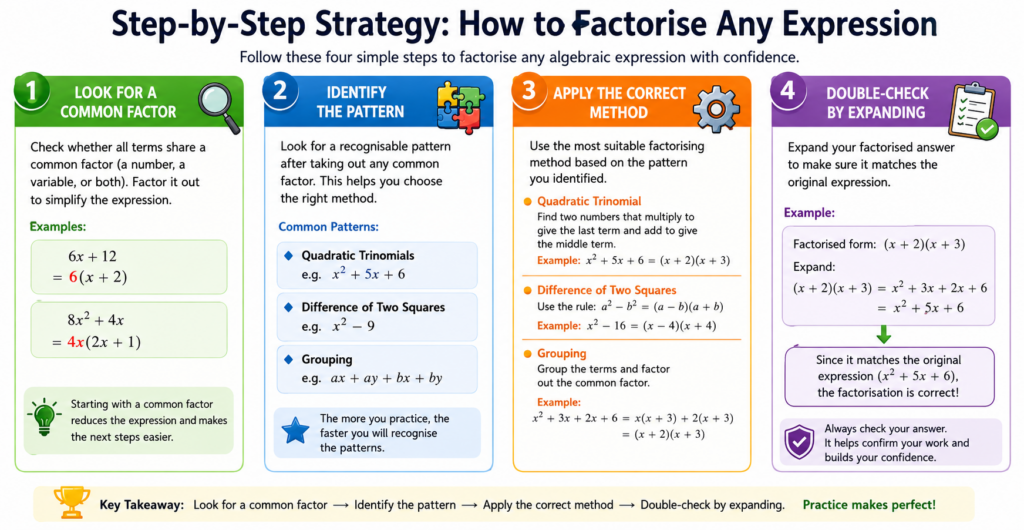
Step-by-Step Strategy: How to Factorise Any Expression

Factorising can seem difficult at first, but it becomes much easier when you follow a simple step-by-step method. Instead of guessing, you can break the process into clear stages and decide which technique fits the expression in front of you. This makes factorising more accurate and much less confusing.

Step 1: Look for a Common Factor

The first thing to do is check whether all terms share a common factor. This could be a number, a variable, or both. Taking out the highest common factor makes the expression simpler and often reveals the next step more clearly.

For example, in 6x + 12, both terms are divisible by 6, so the expression can be written as 6(x + 2). In 8x² + 4x, both terms share 4x, so it becomes 4x(2x + 1).

Starting with a common factor is important because it reduces the expression immediately and helps avoid mistakes later.

Step 2: Identify the Pattern

Once any common factor has been taken out, the next step is to look for a recognisable pattern. Many algebraic expressions follow standard forms, and spotting them quickly helps you choose the correct factorising method.

Some common patterns include:

  • ♦  Quadratics, such as x² + 5x + 6
  • ♦  Difference of two squares, such as x² – 9
  • ♦  Expressions that can be factorised by grouping, such as ax + ay + bx + by

Recognising the pattern is one of the most important parts of factorising. The more practice you get, the faster you will notice which type of expression you are dealing with.

Step 3: Apply the Correct Method

After identifying the pattern, apply the most suitable factorising method.

For a quadratic expression, find two numbers that multiply to give the last term and add to give the middle term. For example, x² + 5x + 6 factorises to (x + 2)(x + 3).

For a difference of two squares, use the rule:
a² – b² = (a – b)(a + b)
So, x² – 16 becomes (x – 4)(x + 4).

For grouping, place terms into pairs and factor out common factors from each pair. For example:
x² + 3x + 2x + 6
becomes
x(x + 3) + 2(x + 3)
which then factorises to
(x + 2)(x + 3).

Using the correct method at the right time makes the whole process more efficient and helps you reach the correct answer with confidence.

Step 4: Double-Check by Expanding

The final step is to expand your factorised answer to make sure it matches the original expression. This is a simple but very important check.

For instance, if you factorise x² + 5x + 6 as (x + 2)(x + 3), expanding it gives:
x² + 3x + 2x + 6 = x² + 5x + 6

Since it matches the original expression, the factorisation is correct.

Checking by expansion helps confirm your work and builds confidence, especially when learning new methods.

Common gallon conversion mistakes explained

Common Mistakes to Avoid

When learning factorising in maths, it’s easy to make small errors that can lead to incorrect answers. Being aware of these common mistakes will help you work more accurately and confidently.

Ignoring Common Factors First

One of the most frequent mistakes is jumping straight into factorising without checking for a common factor. Many expressions can be simplified by taking out the greatest common factor (GCF) first. Skipping this step can make the problem more complicated than it needs to be and may even lead to an incorrect final result.

Sign Errors (+ / − Confusion)

Mixing up positive and negative signs is another common issue. A small sign mistake can completely change the meaning of an expression. For example, when factorising quadratics, choosing the wrong combination of signs will result in an incorrect pair of brackets. Always double-check whether the signs match the original expression.

Choosing the Wrong Factor Pairs

When working with quadratics or larger expressions, selecting the correct pair of factors is essential. Many learners pick factor pairs that multiply correctly but do not add up to the required middle term. It’s important to check both multiplication and addition before finalising your answer.

Not Checking the Final Answer

A simple but often overlooked step is verifying your work. Once you have factorised an expression, expand it again to see if it matches the original. This quick check can help you catch mistakes early and improve your overall accuracy.

Practice Examples

Test your understanding of factorising with these carefully selected problems. They progress from simple to slightly more challenging, helping you build confidence step by step.

1. Easy Level

Factorise the expression:

x2+5xx^2 + 5xx2+5x

2. Easy Level

Factorise:

6y+96y + 96y+9

3. Medium Level

Factorise the quadratic expression:

x2+7x+12x^2 + 7x + 12×2+7x+12

4. Medium Level

Factorise completely:

2×2+10x+122x^2 + 10x + 122×2+10x+12

5. Slightly Tricky

Factorise:

x2−9x^2 – 9×2−9

Answers (For Self-Checking)

  1. 1. x(x+5)x(x + 5)x(x+5)
  2. 2. 3(2y+3)3(2y + 3)3(2y+3)
  3. 3. (x+3)(x+4)(x + 3)(x + 4)(x+3)(x+4)
  4. 4. 2(x+2)(x+3)2(x + 2)(x + 3)2(x+2)(x+3)
  5. 5. (x−3)(x+3)(x – 3)(x + 3)(x−3)(x+3)
Common gallon conversion mistakes explained

Real-Life Applications of Factorising

Factorising is more than just a maths technique—it has practical uses in many real-world fields. By breaking complex expressions into simpler parts, it helps improve efficiency, accuracy, and problem-solving.

Engineering Calculations

In engineering, factorising simplifies complex equations used in areas like structural design and electrical systems. It helps engineers solve problems more efficiently and reduces the risk of errors, leading to safer and more reliable designs.

Coding and Algorithms

In computer science, factorising supports optimisation by simplifying calculations within algorithms. This can improve program speed and efficiency. It is also important in fields like cryptography, where breaking down large numbers is essential for data security.

Financial Modelling

In finance, factorising helps analyse equations related to costs, profits, and investments. It allows analysts to identify key points such as break-even levels, helping businesses make better financial decisions.

Problem-Solving Skills Development

Factorising also improves logical thinking and pattern recognition. It teaches how to break down complex problems into smaller steps, a skill that is useful in both academic work and everyday life.

Conclusion

Factorising in maths is the process of breaking an expression down into smaller parts that multiply together. It usually begins with identifying a common factor shared by all terms, which is the simplest method. As you progress, recognising patterns—such as differences of squares or trinomial forms—becomes essential. Overall, consistent practice is key to mastering different factorising techniques and applying them confidently.

FAQs — What Is Factorising in Math? Methods and Practices

  1. 1. What is factorising in simple terms?
    Factorising means breaking down a number or algebraic expression into smaller parts (factors) that multiply together to give the original value. It’s like reversing multiplication to see what components make up a number or expression.
  2. 2. Why do we use factorisation?
    We use factorisation to make complex problems easier to work with. It helps in solving equations, simplifying algebraic expressions, and understanding the structure of mathematical problems more clearly.
  3. 3. Is factorising the same as simplifying?
    No, they are different. Factorising splits an expression into factors, while simplifying reduces it to a cleaner or shorter form. However, factorising is often a useful step in the simplification process.
  4. 4. What is the easiest method to factorise?
    The simplest method is taking out the common factor from all terms. This involves identifying a number or variable shared across the expression and factoring it out to make the expression easier to handle.
  5. 5. How do you factorise quickly?
    Start by checking for common factors, then look for familiar patterns like squares or grouped terms. With practice, recognising these patterns becomes quicker, making the factorisation process faster and more efficient.
Sam Walker

Article by

Sam Walker

Sam Walker is an education specialist and author at One Education, bringing over 4 years of experience in creating practical resources and strategies to support teachers and enhance student learning.

top

Hear What Our Learners Say About Us

Home Courses Search