What Is IT Service Management and Why Does It Matter? 

June 15, 2026 | 15 minutes | 8 Readers

Imagine arriving at work only to find that your company’s email system is down, employees cannot access essential cloud applications, and customer support tools have stopped functioning. The speed and effectiveness with which these issues are resolved can determine whether the organisation faces a minor setback or a major operational challenge. This is where IT Service Management (ITSM) becomes essential. Rather than focusing solely on fixing technical problems, ITSM provides a structured framework for designing, delivering, supporting, and continuously improving

Imagine arriving at work only to find that your company’s email system is down, employees cannot access essential cloud applications, and customer support tools have stopped functioning. The speed and effectiveness with which these issues are resolved can determine whether the organisation faces a minor setback or a major operational challenge.

This is where IT Service Management (ITSM) becomes essential. Rather than focusing solely on fixing technical problems, ITSM provides a structured framework for designing, delivering, supporting, and continuously improving IT services. By aligning technology with business objectives, ITSM helps organisations enhance operational efficiency, minimise downtime, improve service quality, and deliver better experiences for both employees and customers. As businesses become increasingly dependent on technology, understanding the importance of ITSM is crucial for maintaining reliability, productivity, and long-term success.

What Is IT Service Management (ITSM)?

IT Service Management (ITSM) is the set of processes, practices, and policies used to plan, deliver, operate, and continuously improve IT services within an organisation. Rather than focusing only on technology, ITSM aims to deliver value to users while supporting business objectives.

Simple Example

Without ITSM:

  • Employees report issues through emails, phone calls, or messages.
  • Requests are handled inconsistently.
  • Important issues may be overlooked.

With ITSM:

  • All requests are logged in a central system.
  • Issues are prioritised based on impact and urgency.
  • Progress is tracked from reporting to resolution.
  • Service performance is continuously monitored and improved.

By implementing ITSM, organisations can improve efficiency, enhance service quality, and ensure IT services effectively support business needs.

The Evolution of ITSM: From IT Support to Business Strategy

A common misconception is that IT Service Management (ITSM) is simply an advanced help desk. While ITSM began as a way to manage IT support and resolve technical issues, it has evolved into a strategic business function that aligns technology services with organisational goals.

Today, ITSM supports key business areas, including cloud services, cybersecurity operations, remote work environments, digital transformation initiatives, employee experience management, and enterprise-wide service delivery. Its focus extends beyond fixing problems to improving efficiency, service quality, and business performance.

Many organisations are also adopting Enterprise Service Management (ESM), applying ITSM principles to departments such as HR, finance, facilities management, and customer service. This helps create consistent, efficient, and high-quality service delivery across the entire organisation.

As technology continues to drive business growth, ITSM plays an increasingly important role in supporting innovation, operational excellence, and long-term business success.

If you’re looking to enhance your IT service management expertise and earn a recognised qualification, consider enrolling in the ITIL® 4 Specialist: Drive Stakeholder Value Certification Course. This course explores how to create, deliver, and improve services that meet stakeholder needs while preparing you for the official certification. Advance your professional skills today with One Education.

Core Components of IT Service Management

Core Components of IT Service Management

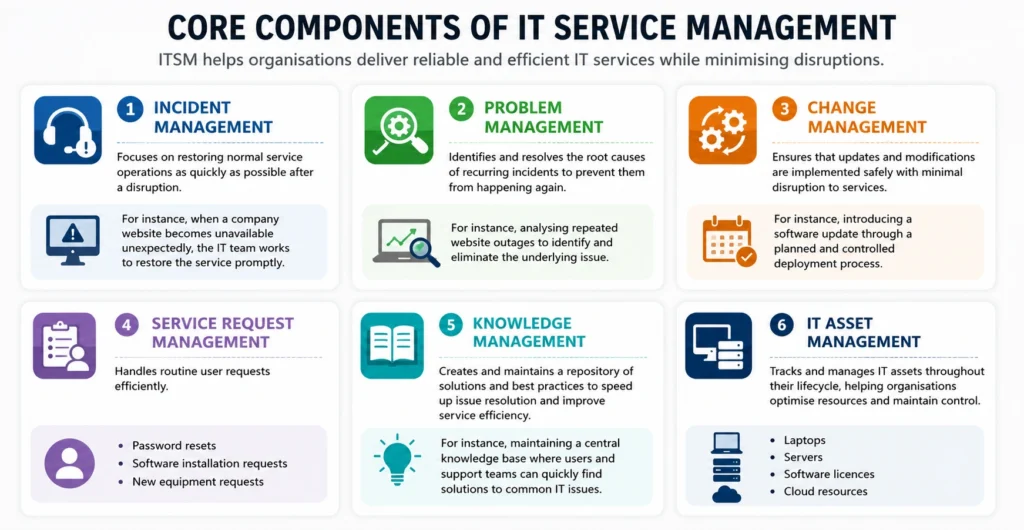
IT Service Management (ITSM) consists of several key components that help organisations deliver reliable and efficient IT services while minimising disruptions.

1. Incident Management

Incident Management focuses on restoring normal service operations as quickly as possible after a disruption.

For instance, when a company website becomes unavailable unexpectedly, the IT team works to restore the service promptly.

2. Problem Management

Problem Management identifies and resolves the root causes of recurring incidents to prevent them from happening again.

For instance, analysing repeated website outages to identify and eliminate the underlying issue.

3. Change Management

Change Management ensures that updates and modifications are implemented safely with minimal disruption to services.

For instance, introducing a software update through a planned and controlled deployment process.

4. Service Request Management

Service Request Management handles routine user requests efficiently.

Common requests include:

  • ♦  Password resets
  • ♦  Software installation requests
  • ♦  New equipment requests

5. Knowledge Management

Knowledge Management creates and maintains a repository of solutions and best practices to speed up issue resolution and improve service efficiency.

For instance, maintaining a central knowledge base where users and support teams can quickly find solutions to common IT issues.

6. IT Asset Management

IT Asset Management tracks and manages IT assets throughout their lifecycle, helping organisations optimise resources and maintain control.

This includes managing:

  • ♦  Laptops
  • ♦  Servers
  • ♦  Software licences
  • ♦  Cloud resources
Why Does ITSM Matter

Why Does ITSM Matter?

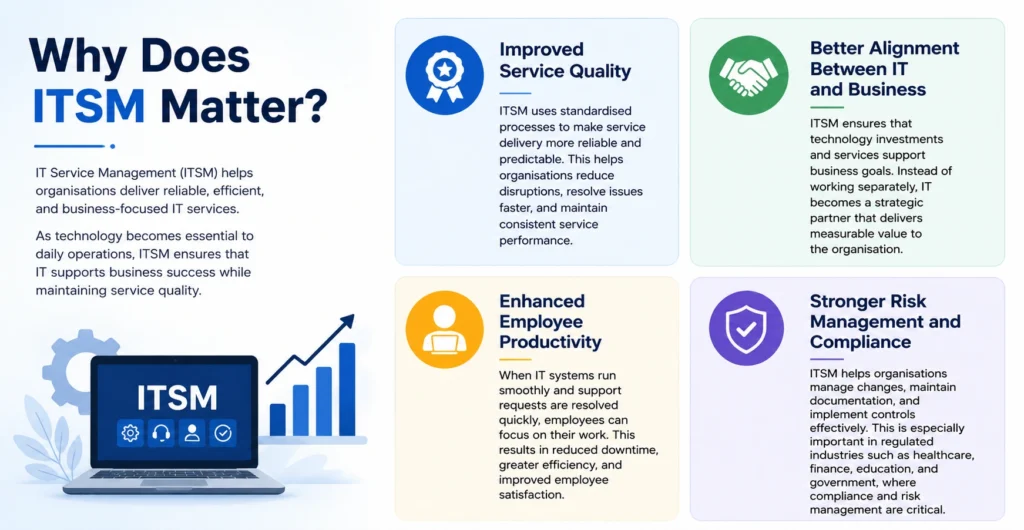
IT Service Management (ITSM) helps organisations deliver reliable, efficient, and business-focused IT services. As technology becomes essential to daily operations, ITSM ensures that IT supports business success while maintaining service quality.

Improved Service Quality

ITSM uses standardised processes to make service delivery more reliable and predictable. This helps organisations reduce disruptions, resolve issues faster, and maintain consistent service performance.

Better Alignment Between IT and Business

ITSM ensures that technology investments and services support business goals. Instead of working separately, IT becomes a strategic partner that delivers measurable value to the organisation.

Enhanced Employee Productivity

When IT systems run smoothly and support requests are resolved quickly, employees can focus on their work. This results in reduced downtime, greater efficiency, and improved employee satisfaction.

Stronger Risk Management and Compliance

ITSM helps organisations manage changes, maintain documentation, and implement controls effectively. This is especially important in regulated industries such as healthcare, finance, education, and government, where compliance and risk management are critical.

The Role of ITIL in IT Service Management

The Role of ITIL in IT Service Management

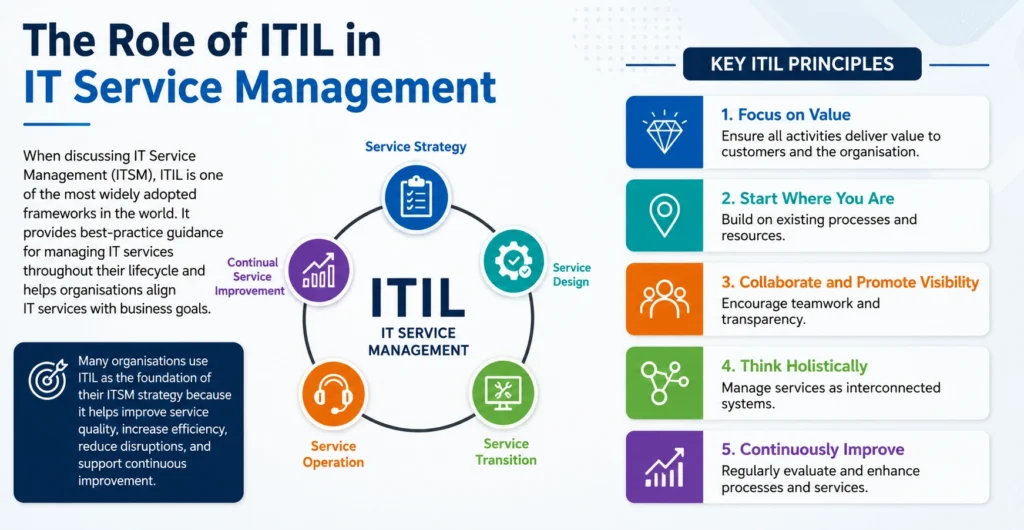
When discussing IT Service Management (ITSM), ITIL is one of the most widely adopted frameworks in the world. It provides best-practice guidance for managing IT services throughout their lifecycle and helps organisations align IT services with business goals.

Key ITIL Principles

  • ♦  Focus on Value – Ensure all activities deliver value to customers and the organisation.
  • ♦  Start Where You Are – Build on existing processes and resources.
  • ♦  Collaborate and Promote Visibility – Encourage teamwork and transparency.
  • ♦  Think Holistically – Manage services as interconnected systems.
  • ♦  Continuously Improve – Regularly evaluate and enhance processes and services.

Many organisations use ITIL as the foundation of their ITSM strategy because it helps improve service quality, increase efficiency, reduce disruptions, and support continuous improvement.

Common ITSM Tools Used by Businesses

Modern IT Service Management (ITSM) depends on specialised software platforms that help organisations streamline IT operations, improve efficiency, and deliver better support services. These tools provide a centralised system for managing incidents, service requests, assets, and workflows.

Some of the most widely used ITSM solutions include:

  • ♦  ServiceNow – A comprehensive ITSM platform that helps businesses automate workflows, manage incidents, track assets, and improve service delivery across the organisation.
  • ♦  Jira Service Management – Designed to support IT and development teams, this platform enables efficient ticket management, incident resolution, and collaboration between departments.
  • ♦  Freshservice – A user-friendly cloud-based solution that offers features such as service desk management, workflow automation, asset tracking, and self-service portals.
  • ♦  SolarWinds Service Desk – An ITSM tool focused on incident management, asset management, and service request handling, helping organisations maintain smooth and reliable IT operations.

These platforms enable businesses to automate repetitive tasks, manage support tickets more effectively, monitor IT assets, and maintain consistent service standards. By using the right ITSM tool, organisations can enhance productivity, reduce response times, and deliver a better experience for both employees and customers.

Emerging ITSM Trends in 2026

Emerging ITSM Trends in 2026

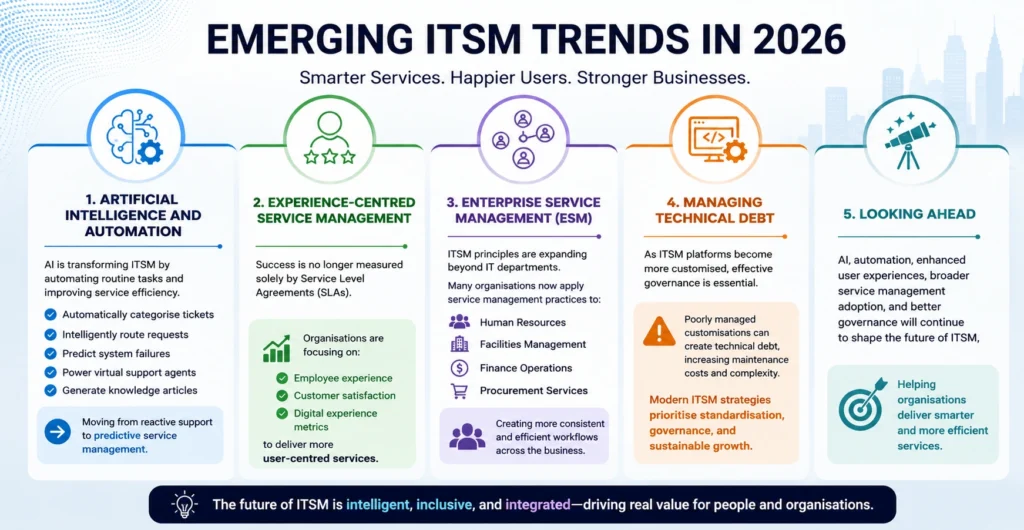
The IT Service Management (ITSM) landscape is evolving rapidly as organisations focus on improving efficiency, user experience, and service delivery. Several key trends are shaping ITSM in 2026.

Artificial Intelligence and Automation

AI is transforming ITSM by automating routine tasks and improving service efficiency. It can automatically categorise tickets, intelligently route requests, predict system failures, power virtual support agents, and generate knowledge articles. As a result, many organisations are moving from reactive support to predictive service management.

Experience-Centred Service Management

Success is no longer measured solely by Service Level Agreements (SLAs). Organisations are increasingly focusing on employee experience, customer satisfaction, and digital experience metrics to deliver more user-centred services.

Enterprise Service Management (ESM)

ITSM principles are expanding beyond IT departments. Many organisations now apply service management practices to Human Resources, Facilities Management, Finance Operations, and Procurement Services, creating more consistent and efficient workflows across the business.

Managing Technical Debt

As ITSM platforms become more customised, effective governance is essential. Poorly managed customisations can create technical debt, increasing maintenance costs and complexity. Modern ITSM strategies therefore prioritise standardisation, governance, and sustainable growth.

Looking Ahead

AI, automation, enhanced user experiences, broader service management adoption, and better governance will continue to shape the future of ITSM, helping organisations deliver smarter and more efficient services.

Challenges Organisations Face When Implementing ITSM

Challenges Organisations Face When Implementing ITSM

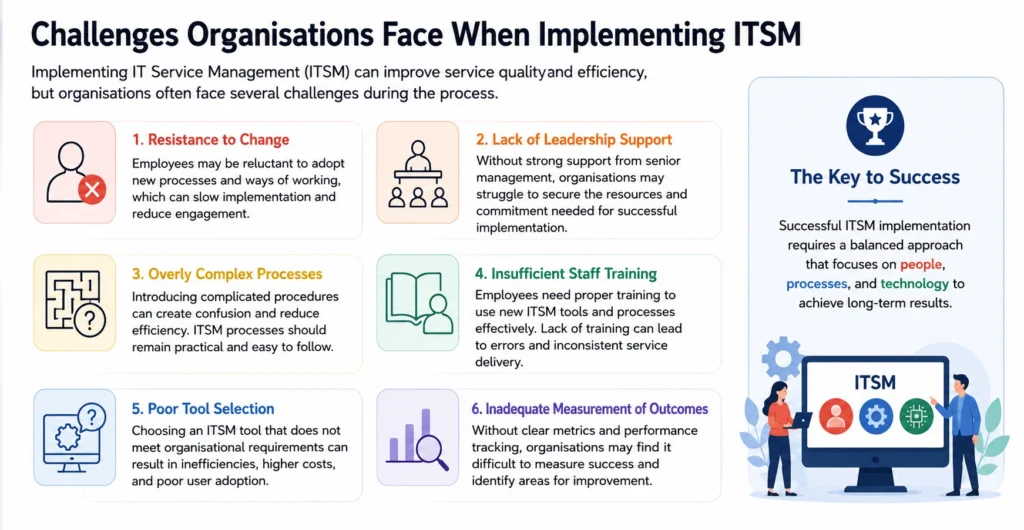
Implementing IT Service Management (ITSM) can improve service quality and efficiency, but organisations often face several challenges during the process.

Resistance to Change

Employees may be reluctant to adopt new processes and ways of working, which can slow implementation and reduce engagement.

Lack of Leadership Support

Without strong support from senior management, organisations may struggle to secure the resources and commitment needed for successful implementation.

Overly Complex Processes

Introducing complicated procedures can create confusion and reduce efficiency. ITSM processes should remain practical and easy to follow.

Insufficient Staff Training

Employees need proper training to use new ITSM tools and processes effectively. Lack of training can lead to errors and inconsistent service delivery.

Poor Tool Selection

Choosing an ITSM tool that does not meet organisational requirements can result in inefficiencies, higher costs, and poor user adoption.

Inadequate Measurement of Outcomes

Without clear metrics and performance tracking, organisations may find it difficult to measure success and identify areas for improvement.

The Key to Success

Successful ITSM implementation requires a balanced approach that focuses on people, processes, and technology to achieve long-term results.

The Future of IT Service Management

The Future of IT Service Management

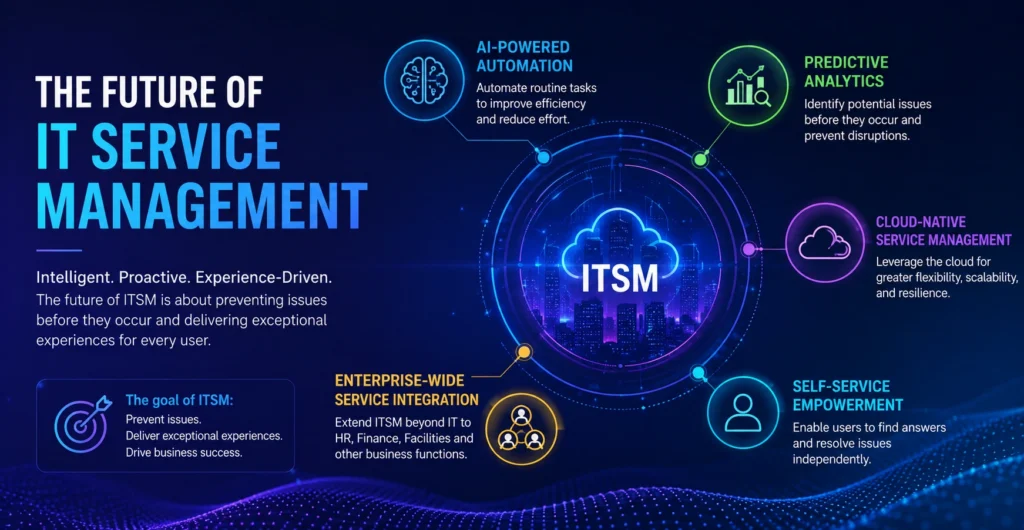
The future of IT Service Management (ITSM) focuses on intelligent, proactive, and experience-driven service delivery. Organisations are increasingly adopting AI-powered automation to streamline routine tasks and improve service efficiency.

Predictive analytics helps identify potential issues before they occur, reducing downtime and preventing disruptions. At the same time, cloud-native service management provides greater flexibility and scalability to support modern business operations.

Growing self-service capabilities enable users to resolve common issues independently, while enterprise-wide service integration extends ITSM practices across departments such as HR, finance, and facilities management.

The future goal of ITSM is not just to resolve issues faster but to prevent them altogether while delivering exceptional user experiences.

Conclusion

IT Service Management (ITSM) plays a vital role in helping organisations deliver reliable, efficient, and high-quality IT services that support their overall business objectives. By adopting structured processes and best practices, businesses can improve service delivery, enhance customer satisfaction, reduce operational disruptions, and make better use of their resources. As technology continues to evolve and businesses become increasingly dependent on digital solutions, effective ITSM provides the foundation for maintaining productivity, driving continuous improvement, and ensuring long-term organisational success. 

FAQs — What Is IT Service Management and Why Does It Matter?

  1. 1. What is IT Service Management (ITSM)?
    IT Service Management (ITSM) is the process of designing, delivering, managing, and improving IT services to meet the needs of an organisation and its users.

  2. 2. Why is IT Service Management important?
    ITSM helps businesses deliver reliable IT services, improve efficiency, reduce downtime, and enhance customer satisfaction.

  3. 3. What are the main goals of ITSM?
    The main goals are to improve service quality, streamline IT processes, increase productivity, and align IT services with business objectives.

  4. 4. How does ITSM benefit businesses?
    ITSM helps businesses reduce operational costs, improve service delivery, minimise disruptions, and support business growth.

  5. 5. What is the difference between ITSM and IT support?
    IT support focuses on resolving technical issues, while ITSM covers the complete management and improvement of IT services and processes.

Sam Walker

Article by

Sam Walker

Sam Walker is an education specialist and author at One Education, bringing over 4 years of experience in creating practical resources and strategies to support teachers and enhance student learning.

top
Home Courses Search