Teaching Assistant Entry Requirements UK: What You Need

November 23, 2026 | By Michael Hansen | 28 minutes | 327 Readers

Thinking about becoming a teaching assistant but unsure whether you have the right qualifications? You may already have useful skills from previous jobs, childcare or volunteering. Understanding the entry requirements is the first step towards exploring this career. Teaching assistant entry requirements in the UK vary depending on the school and position. A university degree is not usually necessary, but employers often look for English and maths qualifications, relevant experience and strong communication skills. Appropriate safeguarding checks are also an

Thinking about becoming a teaching assistant but unsure whether you have the right qualifications? You may already have useful skills from previous jobs, childcare or volunteering. Understanding the entry requirements is the first step towards exploring this career.

Teaching assistant entry requirements in the UK vary depending on the school and position. A university degree is not usually necessary, but employers often look for English and maths qualifications, relevant experience and strong communication skills. Appropriate safeguarding checks are also an important part of recruitment.

There are several routes into classroom support, depending on your qualifications and experience. For a broader overview of the career pathway, see How to Become a Teaching Assistant in the UK. This guide focuses specifically on the qualifications, experience and checks you may need before applying.

What Are the Entry Requirements for a Teaching Assistant in the UK?

There is no single academic qualification required for every teaching assistant position across the UK. Schools set recruitment criteria according to the responsibilities involved.

The National Careers Service teaching assistant profile confirms that applicants in England can enter through college courses, apprenticeships, volunteering or direct applications.

Typical requirements include:

Requirement What Employers Generally Expect
University degree Not usually required
GCSE English and maths Commonly grades 4/C or above, or accepted equivalents
Level 2 or Level 3 qualification Useful or required for certain positions
Previous experience Desirable for many roles, essential for some
Safeguarding checks Appropriate checks for working with children
Personal skills Communication, patience, teamwork and adaptability

The key is to distinguish between essential requirements, which applicants must meet, and desirable criteria, which strengthen an application.

What Qualifications Do You Need to Be a Teaching Assistant?

Teaching assistant qualifications can demonstrate your understanding of classroom support, child development and learning activities. However, the qualifications needed depend on the position.

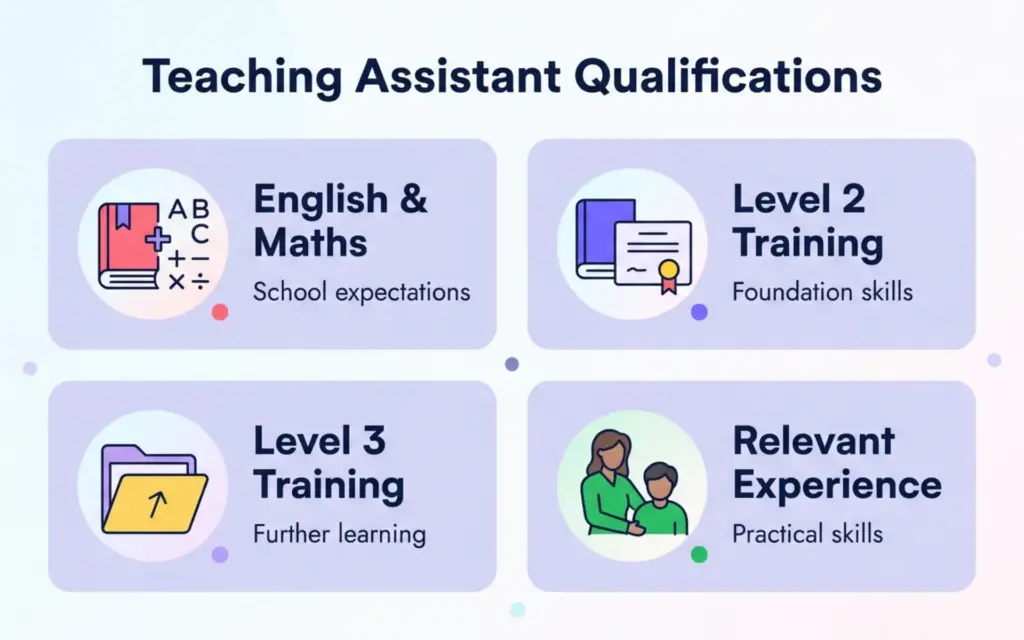
Infographic showing GCSE English and maths, Level 2 and Level 3 qualifications, and relevant experience for teaching assistant jobs in the UK.

GCSE English and Maths Requirements

Many schools in England ask for GCSE English and maths at grades 4/C or above. These subjects matter because teaching assistants frequently help pupils with reading, writing and numeracy.

Some employers accept equivalent qualifications, such as relevant Functional Skills qualifications. Others specify particular GCSE grades.

If you do not have GCSEs, check the vacancy before assuming you are ineligible. The employer can clarify which alternatives it recognises.

Are Level 2 or Level 3 Teaching Assistant Qualifications Required?

Relevant qualifications can improve your preparation and may be essential for particular vacancies.

  • Level 2 qualifications often introduce supporting teaching and learning, classroom responsibilities and working with children.
  • Level 3 qualifications generally provide more advanced knowledge and skills for supporting pupils and learning activities.

However, a qualification’s level alone does not establish whether it meets a school’s requirements.

For instance, an online Level 3 course completion certificate is not automatically equivalent to a regulated Level 3 qualification involving assessed practical competence.

Understanding CPD vs regulated qualifications can help you identify which training supports professional development and which qualifications may meet employers’ formal requirements. 

Always check the qualification title, awarding organisation and assessment requirements.

Do You Need a University Degree?

No. A university degree is not generally required for an ordinary teaching assistant position.

Schools are more likely to consider relevant qualifications, practical experience and your ability to support pupils effectively. Specialist positions may have additional requirements.

Teaching Assistant Readiness Checker

About 90 seconds

Free readiness check

Am I ready to apply for teaching assistant jobs?

Answer 7 quick questions about your qualifications and experience. See what you already meet, any gaps, and a personal action plan for your part of the UK.

  • Qualifications
  • Experience
  • Checks

Loading… If this message doesn’t change, please refresh the page.

Typical teaching assistant requirements by UK nation
  • England
    • Schools set their own criteria.
    • Commonly asked for: GCSE English and maths at grade 4/C, or equivalents such as Functional Skills Level 2.
    • Desirable: a relevant Level 2 or 3 qualification and experience with children.
    • Checks: Enhanced DBS, with a children’s barred list check where duties are regulated activity.
  • Wales
    • Schools set their own criteria, often GCSE grade C or equivalents such as Essential Skills Wales Level 2.
    • Learning support workers must register with the Education Workforce Council.
    • Checks: Enhanced DBS.
  • Scotland
    • Roles are often advertised as classroom assistant or pupil support assistant.
    • Qualifications at SCQF level 4 or 5 may be needed.
    • Experience working or volunteering with children is listed as essential.
    • Checks: PVG scheme membership.
  • Northern Ireland
    • Education Authority essential criteria: a relevant Level 2 qualification plus 6 weeks’ experience, or 12 months’ experience in a formal learning environment.
    • GCSE English and maths are desirable.
    • Checks: AccessNI.

General guidance only: requirements vary by school, role and nation, so always check each vacancy’s essential criteria. Your answers stay in your browser.

Can You Become a Teaching Assistant Without Experience?

Yes, some teaching assistant positions welcome applicants without previous school employment. However, other roles require relevant experience, particularly when supporting pupils with additional needs.

Experience does not always mean having worked in a classroom.

You may already have transferable skills from:

  • Childcare, babysitting or nursery work.
  • Tutoring or helping children with homework.
  • Youth clubs, sports coaching or community activities.
  • Volunteering with children and young people.

For example, someone returning to employment after working in childcare may already understand children’s routines, communication and behaviour.

Schools also value patience, active listening, reliability and the ability to work with teachers and parents.

If you have limited experience, volunteering in a school or community setting may help you become familiar with educational environments. Comparing online teaching assistant courses for beginners can also help you find introductory training that builds relevant knowledge before applying for school-based roles. 

What Background Checks Do Teaching Assistants Need?

Working closely with children involves safeguarding responsibilities, so schools carry out appropriate pre-employment checks.

In England and Wales, teaching assistant roles commonly qualify for an Enhanced Disclosure and Barring Service (DBS) check. A check of the children’s barred list may also be appropriate where the duties constitute regulated activity.

The GOV.UK regulated activity with children guidance explains when particular checks are legally permitted.

Different systems apply elsewhere:

  • Scotland: The Protecting Vulnerable Groups (PVG) scheme applies to regulated roles involving children.
  • Northern Ireland: Relevant criminal-record checks are provided through AccessNI.
UK teaching assistant safeguarding checks infographic comparing DBS in England and Wales, PVG in Scotland and AccessNI in Northern Ireland.

Schools may also verify references, employment history and the applicant’s right to work.

Importantly, completing a teaching assistant course does not replace these checks.

Are Teaching Assistant Requirements Different Across the UK?

Although teaching assistant responsibilities are broadly similar, job titles, qualifications and recruitment arrangements differ across the four UK nations.

Nation Important Considerations
England Individual schools set entry criteria, commonly requesting English and maths GCSEs.
Wales Schools determine requirements, including relevant qualifications and experience.
Scotland Similar positions may be advertised as classroom assistant or pupil support assistant, with Scottish qualification terminology.
Northern Ireland Classroom assistant vacancies may specify recognised qualifications and experience criteria.

Northern Ireland’s Education Authority classroom assistant qualification guidance provides information about relevant qualifications and eligibility criteria for applicable positions.

In Scotland, applicants may encounter National 5 qualifications rather than GCSEs.

The safest approach is to check the recruitment requirements in your own nation, particularly when applying to local authority schools, academy trusts or specialist settings.

How to Prepare for a Teaching Assistant Job Application

Once you understand the basic requirements, compare them with your existing qualifications and experience.

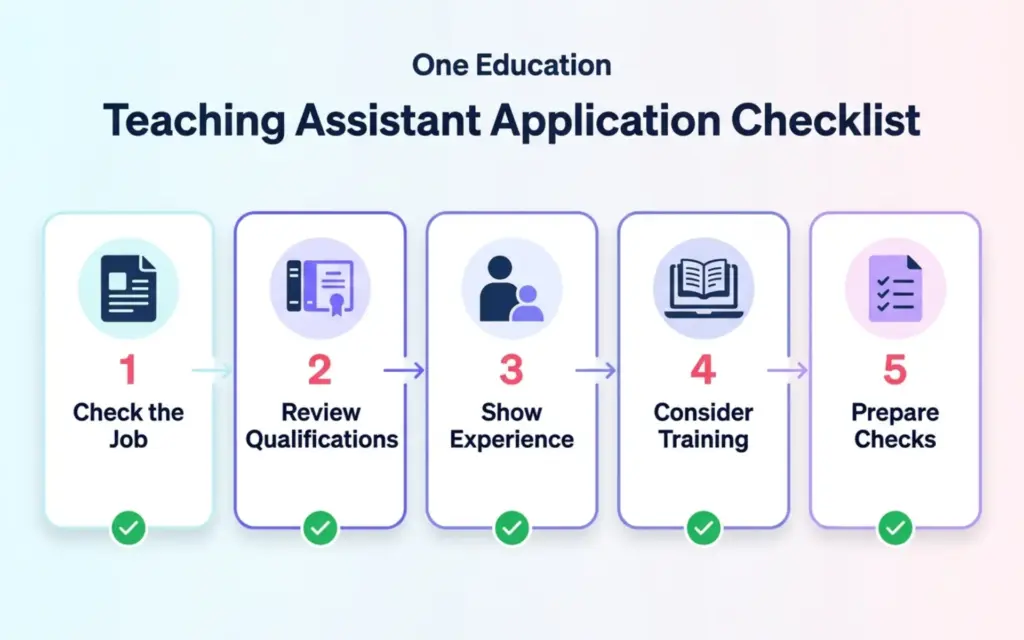
A simple checklist can help.

  1. Read the job description carefully. Separate essential criteria from desirable skills and experience.
  2. Check your qualifications. Confirm whether your GCSEs, equivalents or other certificates meet the employer’s expectations.
  3. Identify transferable experience. Consider childcare, volunteering, tutoring or other relevant work.
  4. Explore suitable training routes. Depending on your circumstances, college courses, apprenticeships or additional learning may help.
  5. Prepare for recruitment checks. Gather references and qualification records, and follow the employer’s safeguarding procedures.
Five-step teaching assistant application checklist covering job criteria, qualifications, relevant experience, training and recruitment checks.

Apprenticeships have their own entry requirements, which should not be confused with the requirements for every teaching assistant vacancy.

The Skills England teaching assistant occupational standard describes the knowledge, skills and behaviours associated with the Level 3 teaching assistant apprenticeship in England.

Can Online Training Help You Prepare for a Teaching Assistant Role?

Online learning can help you develop theoretical knowledge before applying for classroom support positions.

One Education’s Teaching Assistant Complete Course covers teaching fundamentals, classroom management, child development and approaches to supporting pupils with SEN, dyslexia and ADHD.

The course is delivered online and includes video lessons, study materials and assessments. It offers non-regulated training and is not an Ofqual-regulated qualification or a licence to practise professionally.

Checking what teaching assistant certificates include can help you distinguish evidence of course completion from qualifications required for particular jobs. 

Consider it as a way to build relevant knowledge alongside any qualifications, experience or checks required by prospective employers.

Conclusion

Becoming a teaching assistant in the UK does not usually require a university degree, but schools may expect relevant qualifications, practical experience and appropriate safeguarding checks. Requirements also differ depending on the role, employer and UK nation.

If you are considering this career, start by reviewing teaching assistant vacancies in your area. Compare their essential criteria with your existing qualifications, skills and experience to identify where you already meet expectations and where further preparation may help.

Whether you are starting your career or changing professions, relevant training and practical experience can strengthen your application. Focus on developing the skills schools value, checking employer requirements and choosing learning opportunities that support your career goals.

Frequently Asked Questions

Possibly. Some schools accept equivalent qualifications or relevant experience, while others specifically require GCSE English and maths. Check the essential criteria and ask the employer whether your existing qualifications are acceptable.

Not for every position. Some employers require Level 3 qualifications, while others consider applicants with different qualifications or relevant experience. A recognised qualification may improve your suitability for particular roles.

Yes. There is no general upper age limit for entering teaching assistant work. Career changers and people returning to employment can apply, provided they meet the school’s recruitment, suitability and safeguarding requirements.

Yes. A teaching assistant apprenticeship combines employment with structured learning and assessment. Entry requirements vary, so check the particular apprenticeship’s qualifications, eligibility conditions and employer expectations before applying.

Some schools consider applicants with suitable experience and transferable skills even without a teaching assistant qualification. Other positions specify formal training or qualifications. Always check the vacancy’s essential criteria before deciding whether further study is necessary.

top
Home Courses Search

Chat with us