What Is IT Service Management and Why Is It Important?

June 13, 2026 | 15 minutes | 51 Readers

Imagine working in an organisation where employees regularly struggle with software issues, unexpected system outages, and slow IT support responses. As productivity declines, customer satisfaction suffers, and operational costs begin to rise. These challenges are common in businesses that lack an effective system for managing their IT services. This is where IT Service Management (ITSM) plays a crucial role. ITSM is a strategic approach that focuses on designing, delivering, managing, and continuously improving IT services to meet the needs of

Imagine working in an organisation where employees regularly struggle with software issues, unexpected system outages, and slow IT support responses. As productivity declines, customer satisfaction suffers, and operational costs begin to rise. These challenges are common in businesses that lack an effective system for managing their IT services.

This is where IT Service Management (ITSM) plays a crucial role. ITSM is a strategic approach that focuses on designing, delivering, managing, and continuously improving IT services to meet the needs of both the organisation and its customers. Rather than simply fixing technical problems, ITSM helps align IT operations with business objectives, ensuring technology supports growth, efficiency, and long-term success. In today’s technology-driven world, implementing effective IT Service Management has become essential for organisations seeking to enhance service quality, improve user experiences, and maintain a competitive edge.

What Is IT Service Management (ITSM)?

IT Service Management (ITSM) is the structured process of designing, delivering, managing, supporting, and improving IT services throughout their lifecycle. It combines processes, practices, and technologies to ensure IT services meet user needs and business goals.

Rather than focusing only on technology, ITSM aims to:

  • ♦  Deliver value to users
  • ♦  Manage IT services efficiently
  • ♦  Improve customer and employee experiences
  • ♦  Support business objectives

Example of ITSM in Action

When an employee requests a new laptop:

  1. 1. The request is submitted through a service portal.
  2. 2. Approval is completed automatically.
  3. 3. The IT team receives a service ticket.
  4. 4. The laptop is prepared and delivered.
  5. 5. The request is tracked and closed.

This streamlined process is managed using ITSM principles, helping organisations provide reliable, efficient, and user-focused IT services.

The Evolution of IT Service Management

IT Service Management (ITSM) has evolved significantly from traditional IT support. In the past, IT teams focused mainly on fixing technical issues after they occurred. This reactive approach was technology-focused, relied on separate teams, and involved many manual processes, often resulting in limited visibility and slower service delivery.

As businesses became more dependent on technology, organisations shifted towards a more strategic approach. Modern ITSM focuses on managing technology as a service that supports business goals rather than simply resolving technical problems.

Unlike traditional IT support, ITSM takes a proactive approach by identifying and preventing issues before they affect operations. It is business-focused, uses integrated workflows, and provides end-to-end visibility across the entire service lifecycle. Automation also plays a key role, helping organisations improve efficiency, consistency, and service quality.

This evolution has transformed IT from a support function into a strategic business partner, enabling organisations to deliver better services, improve user experiences, and achieve stronger business outcomes.

Why Is IT Service Management Important

Why Is IT Service Management Important?

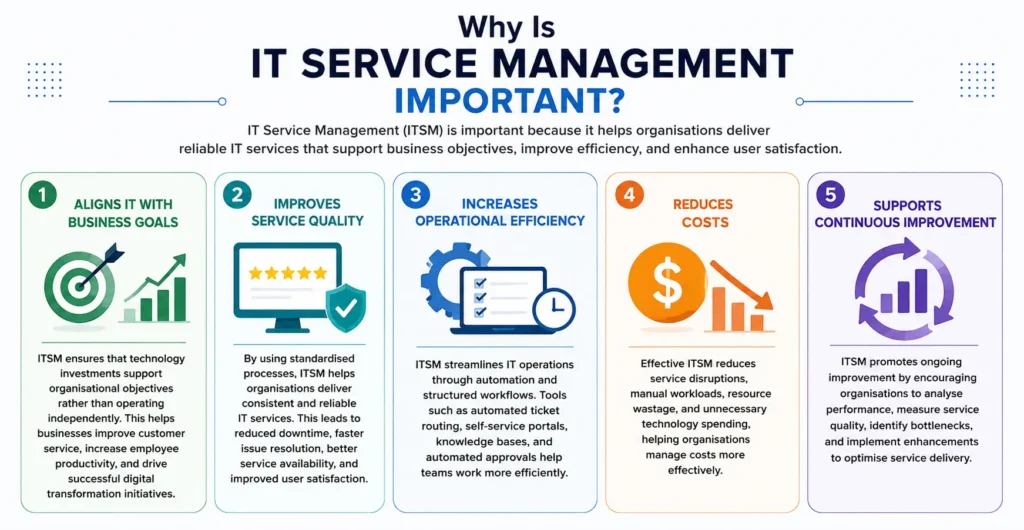
IT Service Management (ITSM) is important because it helps organisations deliver reliable IT services that support business objectives, improve efficiency, and enhance user satisfaction.

1. Aligns IT with Business Goals

ITSM ensures that technology investments support organisational objectives rather than operating independently. This helps businesses improve customer service, increase employee productivity, and drive successful digital transformation initiatives.

2. Improves Service Quality

By using standardised processes, ITSM helps organisations deliver consistent and reliable IT services. This leads to reduced downtime, faster issue resolution, better service availability, and improved user satisfaction.

3. Increases Operational Efficiency

ITSM streamlines IT operations through automation and structured workflows. Tools such as automated ticket routing, self-service portals, knowledge bases, and automated approvals help teams work more efficiently.

4. Reduces Costs

Effective ITSM reduces service disruptions, manual workloads, resource wastage, and unnecessary technology spending, helping organisations manage costs more effectively.

5. Supports Continuous Improvement

ITSM promotes ongoing improvement by encouraging organisations to analyse performance, measure service quality, identify bottlenecks, and implement enhancements to optimise service delivery.

If you’d like to expand your understanding of IT service management and gain a recognised qualification, consider enrolling in the ITIL® 4 Strategist: Direct, Plan, and Improve Certification Course. This course provides valuable insights into strategic planning, continuous improvement, and organisational effectiveness while helping you prepare for certification. Begin your learning journey today with One Education.

Core ITSM Processes Every Organisation Should Know

Core ITSM Processes Every Organisation Should Know

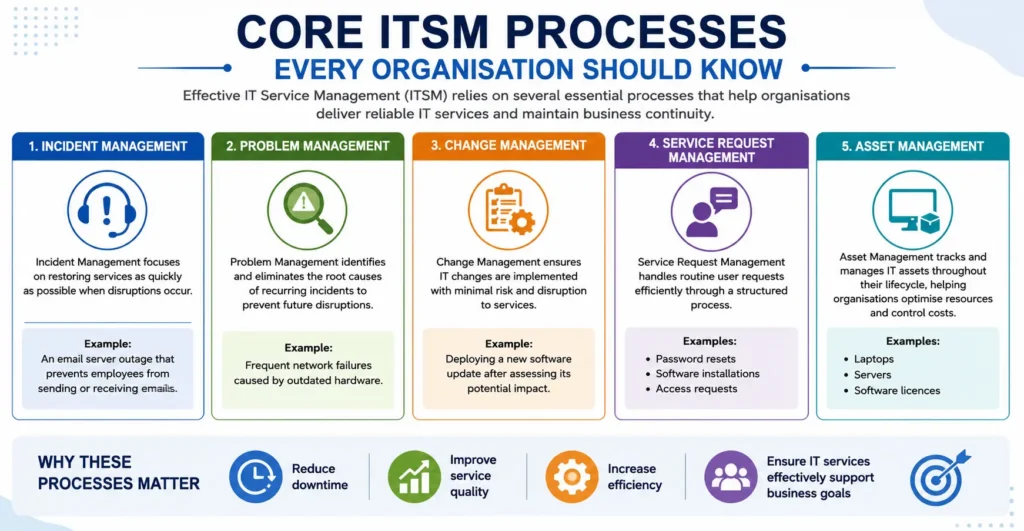
Effective IT Service Management (ITSM) relies on several essential processes that help organisations deliver reliable IT services and maintain business continuity.

Incident Management

Incident Management focuses on restoring services as quickly as possible when disruptions occur.

Example: An email server outage that prevents employees from sending or receiving emails.

Problem Management

Problem Management identifies and eliminates the root causes of recurring incidents to prevent future disruptions.

Example: Frequent network failures caused by outdated hardware.

Change Management

Change Management ensures IT changes are implemented with minimal risk and disruption to services.

Example: Deploying a new software update after assessing its potential impact.

Service Request Management

Service Request Management handles routine user requests efficiently through a structured process.

Examples:

  • ♦  Password resets
  • ♦  Software installations
  • ♦  Access requests

Asset Management

Asset Management tracks and manages IT assets throughout their lifecycle, helping organisations optimise resources and control costs.

Examples:

  • ♦  Laptops
  • ♦  Servers
  • ♦  Software licences

Why These Processes Matter

These core ITSM processes help organisations reduce downtime, improve service quality, increase efficiency, and ensure IT services effectively support business goals.

Popular ITSM Frameworks

Popular ITSM Frameworks

Popular IT Service Management (ITSM) frameworks provide structured approaches to delivering and improving IT services. Among the most widely used are ITIL (Information Technology Infrastructure Library), which focuses on aligning IT services with business needs, COBIT, which emphasizes governance and risk management, and ISO/IEC 20000, the international standard for IT service management. These frameworks help organisations improve service quality, enhance efficiency, manage risks, and ensure consistent delivery of IT services.

ITIL (Information Technology Infrastructure Library)

ITIL is the most widely adopted ITSM framework, providing best practices for managing and improving IT services. It helps organisations align IT services with business goals while delivering value to customers.

Key focus areas include:

  • ♦  Service Value Creation – Ensuring IT services deliver business and customer value.
  • ♦  Continuous Improvement – Regularly enhancing services and processes.
  • ♦  Customer-Centric Service Delivery – Focusing on customer needs and satisfaction.

DevOps and ITSM

Many modern organisations combine DevOps and ITSM to achieve both agility and service quality.

  • ♦  ITSM provides governance, service quality, and structured processes.
  • ♦  DevOps promotes collaboration, automation, and faster service delivery.

By integrating both approaches, organisations can deliver reliable, high-quality services while responding quickly to changing business and customer demands.

How AI Is Transforming IT Service Management

How AI Is Transforming IT Service Management

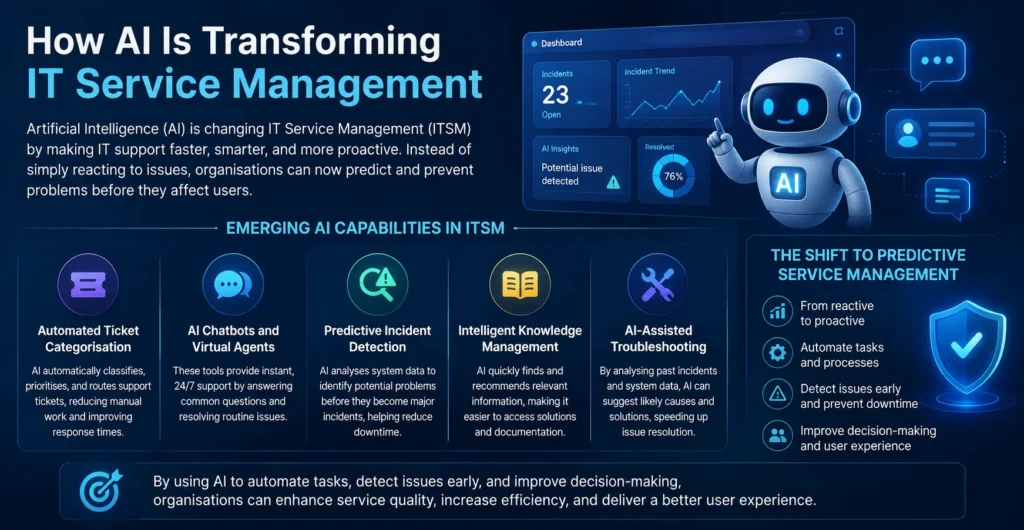
Artificial Intelligence (AI) is changing IT Service Management (ITSM) by making IT support faster, smarter, and more proactive. Instead of simply reacting to issues, organisations can now predict and prevent problems before they affect users.

Emerging AI Capabilities in ITSM

  • ♦  Automated Ticket Categorisation: AI automatically classifies, prioritises, and routes support tickets, reducing manual work and improving response times.
  • ♦  AI Chatbots and Virtual Agents: These tools provide instant, 24/7 support by answering common questions and resolving routine issues.
  • ♦  Predictive Incident Detection: AI analyses system data to identify potential problems before they become major incidents, helping reduce downtime.
  • ♦  Intelligent Knowledge Management: AI quickly finds and recommends relevant information, making it easier to access solutions and documentation.
  • ♦  AI-Assisted Troubleshooting: By analysing past incidents and system data, AI can suggest likely causes and solutions, speeding up issue resolution.

The Shift to Predictive Service Management

Modern ITSM is moving from reactive support to predictive service management. By using AI to automate tasks, detect issues early, and improve decision-making, organisations can enhance service quality, increase efficiency, and deliver a better user experience.

Real-World Benefits of ITSM

Real-World Benefits of ITSM

IT Service Management (ITSM) provides valuable benefits for employees, IT teams, and businesses by improving service quality, efficiency, and overall performance.

For Employees

  • ♦  Faster support through structured service processes.
  • ♦  Reduced downtime, allowing staff to work without unnecessary interruptions.
  • ♦  Better digital experiences with reliable and user-friendly IT services.

For IT Teams

  • ♦  Increased efficiency by streamlining workflows and automating routine tasks.
  • ♦  Better workload management through effective prioritisation and resource allocation.
  • ♦  Improved visibility into incidents, assets, and service performance for better decision-making.

For Businesses

  • ♦  Lower costs by reducing downtime and optimising IT resources.
  • ♦  Higher productivity as employees can work more effectively.
  • ♦  Improved customer satisfaction through reliable and responsive services.
  • ♦  Better compliance and governance by following established policies, regulations, and security standards.

By supporting employees, IT teams, and business goals, ITSM helps organisations deliver reliable, efficient, and high-quality IT services.

Common Challenges in ITSM Implementation

While IT Service Management (ITSM) provides many benefits, organisations often face several challenges during implementation.

Resistance to Change

Employees may be reluctant to adopt new processes and systems, which can slow implementation and reduce effectiveness.

Poor Process Adoption

Teams may continue using old methods instead of following standardised ITSM procedures, leading to inconsistencies and inefficiencies.

Lack of Employee Training

Without proper training, employees may struggle to use ITSM tools effectively, resulting in errors and lower productivity.

Over-Customisation of ITSM Tools

Excessive customisation can make ITSM platforms more complex, difficult to maintain, and harder to upgrade in the future.

Technical Debt Accumulation

Outdated systems and temporary fixes can limit the success of ITSM implementation and create ongoing maintenance challenges.

Addressing these challenges through effective planning, training, and change management can help organisations achieve a successful ITSM implementation.

Future Trends in IT Service Management

Future Trends in IT Service Management

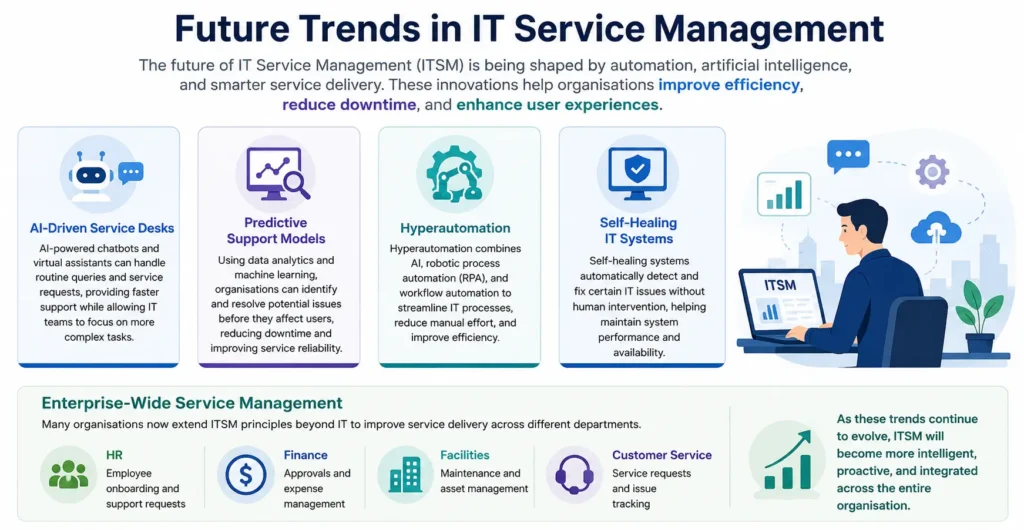
The future of IT Service Management (ITSM) is being shaped by automation, artificial intelligence, and smarter service delivery. These innovations help organisations improve efficiency, reduce downtime, and enhance user experiences.

AI-Driven Service Desks

AI-powered chatbots and virtual assistants can handle routine queries and service requests, providing faster support while allowing IT teams to focus on more complex tasks.

Predictive Support Models

Using data analytics and machine learning, organisations can identify and resolve potential issues before they affect users, reducing downtime and improving service reliability.

Hyperautomation

Hyperautomation combines AI, robotic process automation (RPA), and workflow automation to streamline IT processes, reduce manual effort, and improve efficiency.

Self-Healing IT Systems

Self-healing systems automatically detect and fix certain IT issues without human intervention, helping maintain system performance and availability.

Enterprise-Wide Service Management

Many organisations now extend ITSM principles beyond IT to improve service delivery across different departments, including:

  • ♦  HR: Employee onboarding and support requests
  • ♦  Finance: Approvals and expense management
  • ♦  Facilities: Maintenance and asset management
  • ♦  Customer Service: Service requests and issue tracking

As these trends continue to evolve, ITSM will become more intelligent, proactive, and integrated across the entire organisation.

Conclusion

IT Service Management (ITSM) plays a vital role in helping organisations deliver efficient, reliable, and high-quality IT services that support their overall business objectives. By adopting structured processes and best practices, ITSM improves service delivery, enhances customer satisfaction, reduces operational disruptions, and ensures better use of IT resources. As technology continues to evolve and businesses become increasingly dependent on digital systems, effective IT service management remains essential for maintaining productivity, driving continuous improvement, and enabling organisations to stay competitive in a rapidly changing environment.

FAQs — What Is IT Service Management and Why Is It Important?

  1. 1. What is IT Service Management (ITSM)?
    IT Service Management (ITSM) is the process of designing, delivering, managing, and improving IT services to meet the needs of an organisation and its users.
  2. 2. Why is IT Service Management important?
    ITSM helps organisations provide reliable IT services, improve efficiency, reduce downtime, and enhance customer satisfaction.
  3. 3. What are the main goals of ITSM?
    The main goals of ITSM are to align IT services with business objectives, improve service quality, minimise disruptions, and ensure continuous improvement.
  4. 4. How does ITSM benefit businesses?
    ITSM improves productivity, streamlines workflows, reduces operational costs, strengthens security, and helps organisations deliver better customer experiences.
  5. 5. What are the key processes involved in ITSM?
    Common ITSM processes include incident management, problem management, change management, service request management, and asset management.
  6. 6. What is incident management in ITSM?
    Incident management focuses on restoring normal service operations as quickly as possible when an IT issue or disruption occurs.
Sam Walker

Article by

Sam Walker

Sam Walker is an education specialist and author at One Education, bringing over 4 years of experience in creating practical resources and strategies to support teachers and enhance student learning.

top
Home Courses Search